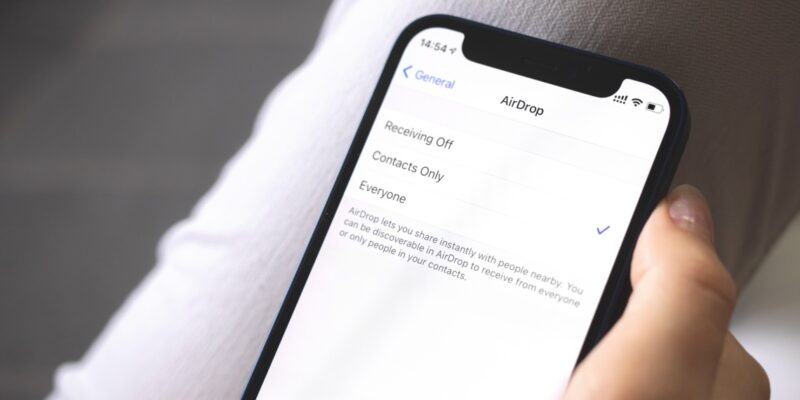
A Chinese institution has developed a tool that can decipher the phone number, email address, and device name of anyone who uses Apple’s AirDrop feature to share content deemed malicious or inappropriate.
The “AirDrop hash conversion tool,” created by Beijing’s Wangshendongjian Judicial Appraisal Institute, digs up this data by decrypting device logs. AirDrop allows users to share files with other Apple devices nearby, wirelessly. It has been used by dissidents in China and Hong Kong in the past.
In a report on Jan. 8, the Beijing Municipal Judicial Bureau said people with “malicious” intent are using AirDrop to transmit illegal videos, pictures, audio, and other files to nearby people in crowded areas like shopping malls, buses, and subways.
While China’s strict internet censorship is well known, law enforcement can’t monitor AirDrop exchanges since it doesn’t use the internet.
“Due to the anonymity and tracking difficulty of AirDrop.. it is necessary to find out the sending source and identify it as soon as possible to avoid adverse effects,” a translation of the report reads.
How Does the Tool Work?
AirDrop — Apple’s Bluetooth file-sharing feature — presents a challenge for the Chinese government as it facilitates the anonymous transmission of potentially “bad information,” the Beijing Municipal Judicial Bureau said.
The new tool will counter this by unraveling data logs from iPhones. It uses a “Rainbow Table,” a method for deciphering encrypted (scrambled) data. Basically, the tool can unscramble information (ciphertext) and translate it into a readable form (plaintext).
This allows law enforcement to access the phone numbers and email addresses of people sending messages via AirDrop.
The report mentioned an incident where members of the public received “a video with inappropriate remarks in the Bejing Subway” from an anonymous sender via AirDrop, adding that others have started imitating the practice.
How to Keep Your Online Activities From Prying Eyes
If you’re traveling or living in China, we recommend you avoid using AirDrop to send or receive files in public places. If you’re looking to send and receive files online or access the web anonymously in China, use a solid VPN, like NordVPN, to encrypt your files and messages.
We’ve tested many VPNs, and NordVPN is the best VPN for China. It’s one of the few VPNs that can bypass the Great Firewall of China. Also, it comes with multiple features, like its kill switch and obfuscated servers, that keep you safe and anonymous online.
Note: We recommend installing NordVPN before entering China to avoid coming up against restrictions. The nation has a tough stance against foreign VPNs.
For more news, follow us on X (Twitter), Threads, and Mastodon!