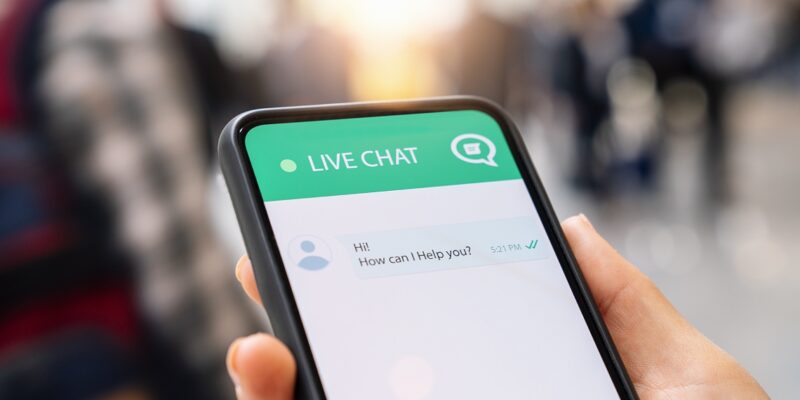

Many people seek to create a human connection with customer support by flirting, NordVPN said in a press release on Tuesday, warning that this could be “dangerous” for privacy as people tend to reveal a lot of sensitive information when they flirt.
“Many users are still unaware that on most occasions when they ask for customer support, it’s usually a chatbot, not a human being,” Adrianus Warmenhoven, a NordVPN cybersecurity expert, said.
The popular VPN provider cited a survey by Infobip published in February, which revealed that nearly 20% of Americans engage in flirtatious conversations with AI (artificial intelligence) chatbots.
Besides sharing personal information when flirting with customer support chatbots, NordVPN said people often disclose sensitive information like their ID or social security number in a bid to get customer support to solve their problems quickly. And, this puts their privacy at risk.
All the information users share with customer support chatbots is stored and used to train AI models, NordVPN said. This data may also end up in the wrong hands due to cyberattacks or data leaks.
Risks of Flirting With Customer Support Chatbots
“Engaging in flirtatious conversations with chatbots is dangerous in terms of digital privacy. Customers tend to reveal way more personal information to the chatbot than they should just to impress an imaginary person on the other side of the wire,” NordVPN explained in its press release.
Flirting with chatbots may seem alien to some, but Infobip’s survey revealed that chatbots are increasingly being perceived not just as tools for tasks or information retrieval but as potential companions.
NordVPN cautioned against this trend, warning that sharing personal information with data-hungry AI chatbots puts your privacy at risk.
“While turning to AI for support functions is unavoidable, consumers will have more responsibility for what data should be shared with a chatbot. They must be extra cautious about the information they disclose, since they cannot know how this information will manifest as outputs at some point in the future, especially knowing that in some cases this data is used for teaching algorithms,” Warmenhoven explained.
Cybercriminals can also exploit bugs, unintentional “backdoors,” and other vulnerabilities in AI chatbots to access users’ sensitive information. This could result in identity theft and put you in the crosshairs of threat actors.
How to Use Chatbots Safely
NordVPN’s warning echoes a recent study by the Mozilla Foundation, which revealed that romantic AI chatbots collect vast amounts of personal information about users and do not do enough to keep this data safe.
To protect your privacy, Warmenhoven recommends being cautious of the information you share when speaking to chatbots.
“The main rule is not to provide more information than is needed to resolve the issue,” he noted. “There is no need to flirt with a chatbot or share really personal information that you don’t want to become public in case of a leak.”
Warmenhoven also warns against sharing any information that can identify you or others in messages to customer support chatbots. He suggests using general identifiers like order numbers for online shopping inquiries or booking numbers for flight arrangements. These identifiers should suffice for the service to recognize your case.
“Do not provide a chatbot with an ID, social security, or bank card number. And do not sign your message with your name and last name, as this is not a love letter,” Warmenhoven added.
“To protect your identity from cybercriminals, always request a verification email from the chatbot. This is nothing new, but it is an effective tool, and reputable businesses have this function in their privacy protection toolbox,” he said.
For more safety tips, check out our article on the privacy risks of AI chatbots.
For more news, follow us on X (Twitter), Threads, and Mastodon!