NordVPN is the best VPN for Iran in 2026, as it works extremely well in Iran due to the quick IP changes of its servers and obfuscation, while also delivering fast connection speeds in all its 149+ locations.

The Iranian government controls, monitors, and censors all online activity. Because of this, many social media and communication platforms, like Facebook, Telegram, and WhatsApp, are often blocked without any further explanation. Such strict internet access control makes it extremely hard for people in Iran to access information and just as hard for those outside the country to track what’s happening there. The censorship situation worsened exponentially since the start of the Iran – Israel conflict on June 13th, seeing a rise of interest in VPNs for Iran, both from local users and those from abroad, trying to follow Iranian news on the ground or connect to social media platforms.
The research team at VPNOverview and I reviewed over 20 VPN services to find ones that truly work in Iran. I scrutinized each provider’s privacy policies and security features and tested performance on censored networks. While we did not have the chance to test these VPNs directly in Iran, we’ve recreated a similar network environment for our in-house tests and assessed how well each VPN held up. Ultimately, I selected 5 VPNs we found to be the most secure and reliable for accessing Iranian content in the country or from abroad. Read more to learn about these trustworthy Iranian VPNs and my tips on using them optimally in restrictive conditions.
My recommended VPNs that work in Iran today
Based on my latest 2026 tests and censorship bypass evaluations, here are the top 5 VPNs that reliably work in Iran today, ranked for security, speed, obfuscation, and value.
DISCLAIMER:
Using a VPN is illegal in Iran, with the government actively blocking such services. VPNs can only be used legally in Iran with an official government-issued permit. However, even with such a permit, using a VPN to access blocked sites is against the law. I strongly recommend following the local laws when considering a VPN to avoid legal trouble. That said, I used secure VPNs in the country numerous times and encountered no issues.
Best VPN for Iran 2026: detailed overview
Strong encryption and stealth protocols are essential features to look for in a VPN for Iran. A strict no-logs policy is just as important as a kill switch, servers near Iran, and, ideally, support for manual configuration if the VPN apps are blocked. My testing showed that NordVPN, Surfshark, Proton VPN, Cyberghost, and ExpressVPN are the best VPNs for Iran, working reliably in the country and providing users with the utmost security.
Below, we offer you a more detailed overview of each VPN’s key characteristics.
1. NordVPN – best VPN for Iran 2026 overall
| Rating: | 9.3 |
| Servers: | 8900 servers in 149+ countries |
| Price: | $ 3.49/month + 3-day free trial + 30-day money-back guarantee |
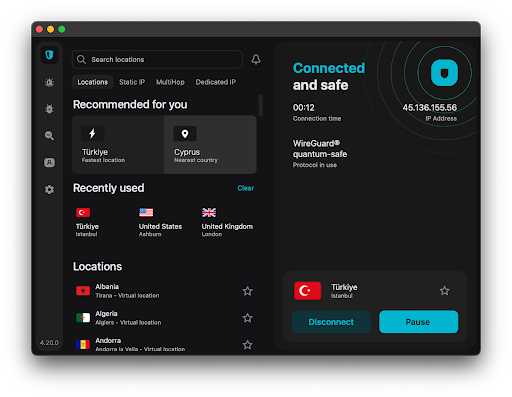
I chose NordVPN as the best overall VPN for Iran due to its iron-clad security features and strict no-logs policy. Additionally, NordVPN offers the NordWhisper protocol, which is meant to bypass strict censorship. Moreover, NordVPN supports manual configuration, which is a good choice if you have difficulty downloading the app due to restrictions.
In total, NordVPN has over 8900 servers in 149+ countries. While the provider has no servers in Iran, you can connect to nearby countries, including Turkey, the UAE, and Georgia. So, while NordVPN won’t give you an Iranian IP address due to the lack of servers there, it can be instrumental in accessing blocked websites and social media platforms within the country. If you’re using NordVPN in Iran, I recommend selecting the NordWhisper tunneling protocol or OpenVPN with obfuscated servers and double-checking if the kill switch is on to prevent IP slippage.

During my NordVPN speed tests, I got an average connection speed of about 468Mbps with a 96% initial speed retention rate. Such speeds are excellent for all online activities, including streaming and downloading. Plus, NordVPN is the fastest VPN on my list. However, the speed of your connection highly depends on the speed of your baseline connection, and if yours isn’t very speedy to begin with, try using the NordLynx protocol as it is faster.
I liked a lot of the features offered by NordVPN, which were specifically useful for use in Iran. For instance, the Obfuscated servers help mask VPN traffic as regular HTTP traffic, which is particularly useful for bypassing Deep Packet Inspection used by Iranian authorities. Meanwhile, the manual OpenVPN configuration support makes NordVPN a good choice if the app is blocked. With DNS encryption, NordVPN successfully hides browsing activities from Iranian ISPs. The few things I found NordVPN to be lacking were the Iranian servers for a local IP address and the fact that there was no option for Shadowsocks or Stealth tools.
Currently, NordVPN is available for $ 3.49/month with the 2-year plan. If you’d rather test it out first, you can use the 3-day free trial for Android devices or extend the period of free use with the 30-day money-back guarantee.
2. Surfshark – cheapest Iran VPN with a large server network
| Rating: | 9.0 |
| Servers: | 4500 in 100+ countries |
| Price: | $ 2.49/month + 7-day free trial + 30-day money-back guarantee |
Surfshark is one of the best VPN choices for Iran as it offers affordable prices but does not compromise on security features, such as Camouflage and NoBorders mode, a reliable kill switch, and manual configuration support.
In total, Surfshark operates around 4500 servers in 100+ countries. The provider does not have Iranian servers for a local IP address, but those within the country can connect to a server in nearby countries, like Turkey, the UAE, Kazakhstan, and Georgia, for optimal performance. I recommend using the Camouflage mode, which is similar to obfuscation, when connecting to a Surfshark server within Iran for better security.
When I tested Surfshark’s connection speeds, I found the average to be around 466Mbps with a 94% initial speed retention rate. This is very close to the speeds of NordVPN, so you can expect a very smooth experience when using Surfshark.
Surfshark offers a whole range of advanced security and privacy features, and from my experience, several of them stood out when using the VPN in a heavily censored environment. To begin with, Surfshark has a very reliable kill switch that prevents accidental IP slips. Then, there’s the NoBorders mode that automatically detects restricted networks, like those in Iran, and offers the safest possible server to connect to. There’s also the Camouflage mode that masks your VPN traffic, making it safer to use within the country. However, I found that the Camouflage mode only works with OpenVPN, which is the slowest available tunneling protocol.
Surfshark is a very affordable service and comes at $ 2.49/month with the 2-year plan. You can test this VPN during the 7-day free trial before purchasing, or use it for free for 30 days with the money-back guarantee.
3. Proton VPN – freemium VPN that works outside Iran
| Rating: | 8.9 |
| Servers: | 20700 servers in 149+ countries |
| Price: | $ 2.99/month + limited free version |
Proton VPN is an excellent VPN choice for Iran, as it offers a secure, obfuscated tunneling Stealth protocol, made to be used in restrictive countries specifically. Additionally, Proton VPN is Swiss-based (not part of the “Eyes” surveillance alliances) and adheres to a strict no-logs policy, while its Secure Core servers improve user privacy.
Overall, Proton VPN has over 20700 servers in around 149 countries. Similar to most of the VPNs on my list, it does not have local Iranian servers. However, if you’re using it from within the country, you can connect to plenty of nearby locations, including Turkey, Pakistan, the UAE, and Georgia. To be on the safer side, I recommend using Proton VPN with the Stealth protocol to mask your VPN usage.
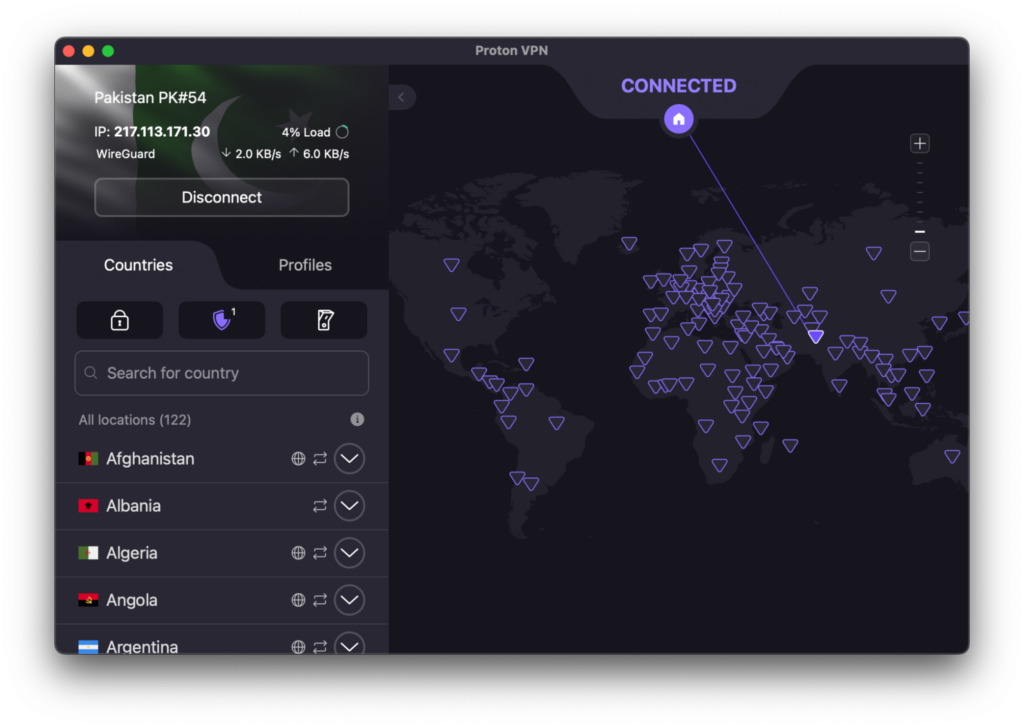
When I ran speed tests for Proton VPN, I found it to be slightly slower than my top choices, with the average connection speed of 438Mbps with an 88% initial speed retention rate. While the difference isn’t huge, the lower retention rate might be tangible if your internet connection is already quite slow.
During my investigation, I found that Proton VPN has quite a few useful features to use while in Iran. For instance, Proton VPN has Tor over VPN servers that route your traffic through a VPN server and a Tor browser. Ultimately, this makes your activities completely undetectable, but it does slow down your connection speeds. Additionally, the service has a Stealth protocol, which masks your VPN usage, while the Secure Core servers route your traffic through two servers. So, there’s a lot to choose from when it comes to anonymity. However, remember that Proton VPN is not as fast as NordVPN or Surfshark, and it does not have any Iranian servers for a local IP address.
A Proton VPN subscription starts from $ 2.99/month with the 2-year plan. Although there’s no free trial, you can test out the service’s free version, but do be careful using it inside Iran, as it does not have the same advanced security features as the premium version. Lastly, if you decide to subscribe, your purchase will be protected by the 30-day money-back guarantee.
4. CyberGhost – user-friendly VPN with servers in Iran
| Rating: | 8.8 |
| Servers: | 9800 servers in 100+ countries |
| Price: | $ 1.99/month + 7-day free trial + 45-day money-back guarantee |
CyberGhost is a solid Iran VPN with virtual servers within the country, perfect for obtaining an Iranian IP address. Additionally, this VPN is quite inexpensive, while its Romanian jurisdiction ensures the highest level of user data privacy.
CyberGhost operates a fleet of 9800 servers in around 100 countries. This is the only VPN service on my list with virtual servers in Iran, making it a good choice for those who want to access local websites from abroad. Besides Iran, it also has quite a few servers in neighboring countries, including Turkey, the UAE, and Georgia. My tip is to make sure the kill switch is turned on before connecting to any of these servers, to prevent any accidental slips of your real IP address.

CyberGhost did quite well during my speed tests, and I achieved an average connection speed of around 456Mbps with a 91% initial speed retention rate. However, I got the best speeds when connected to servers close to my physical location, while faraway connections were significantly slower.
Personally, I was able to get an Iranian IP address from outside the country quite easily, but was not as happy with the VPN being used in the controlled and censored environment. That is because CyberGhost lacks advanced privacy features, such as obfuscation or Stealth protocol, which may make it less secure to be used in Iran. However, I liked that CyberGhost allows for manual configuration, making it easier to use this service where the app itself might be restricted.
Cyberghost subscriptions are competitively priced and start from $ 1.99/month with the 2-year plan. The provider offers one of the longest money-back guarantees in the industry, lasting a full 45 days. Additionally, it also offers a 7-day free trial.
5. ExpressVPN – secure VPN for accessing restricted content in Iran
| Rating: | 8.5 |
| Servers: | 3000 servers in 113+ countries |
| Price: | $ 2.99/month + 30-day money-back guarantee |
ExpressVPN makes for a good Iran VPN choice due to its proprietary Lightway tunneling protocol, known for its good censorship-bypassing capabilities. Additionally, the service has built-in obfuscation and uses RAM-only servers for more security, but it is pricier than the rest of the VPNs on my list.
Overall, ExpressVPN has around 3000 servers in 113+ countries. While it has no servers in Iran, it offers quite a good selection of servers in nearby countries, including Turkey, the UAE, and Georgia. I recommend using the Lightway protocol when connecting to one of ExpressVPN’s servers, as it is the most reliable at bypassing censorship and is very stable with slower initial connections.

During my speed tests, I found that ExpressVPN performed the fastest when using the Lightway protocol. With it, I got an average connection speed of 455Mbps with a 91% initial speed retention rate, which is very close to the speeds I got with CyberGhost. However, if your initial connection speed is particularly slow, I recommend using the Split Tunneling feature to route only sensitive app traffic via VPN connection. At the same time, your other apps run on a regular connection, making them perform a bit faster.
Besides the ExpressVPN features I already listed in my review, the service is also compatible with manual configuration, offers a reliable kill switch, and a third-party verified no-logs policy for user data security. However, ExpressVPN does not offer any servers in Iran for a local IP address and has limited censorship bypass tools.
ExpressVPN is the priciest VPN service on my list, with subscriptions starting at a high $ 2.99/month. Unfortunately, the service does not offer a free trial, but it does have a 30-day money-back guarantee for risk-free testing.
Best VPN for Iran 2026 compared
| Best VPN for Iran | VPN Rating | Servers in Iran? | Worldwide servers | Price |
|---|---|---|---|---|
| 1. NordVPN | ⭐⭐⭐⭐⭐ | ✅ Yes, near Iran in UAE, Turkey, Georgia | 8900 servers in 149+ countries | $ 3.49/month |
| 2. Surfshark | ⭐⭐⭐⭐⭐ | ✅ Yes, near Iran in UAE, Turkey, Georgia, Kazakhstan | 4500 in 100+ countries | $ 2.49/month |
| 3. Proton VPN | ⭐⭐⭐⭐⭐ | ✅ Yes, near Iran in UAE, Turkey, Pakistan, Georgia | 20700 servers in 149+ countries | $ 2.99/month |
| 4. Cyberghost | ⭐⭐⭐⭐ | ✅ Yes, virtual servers in Iran | 9800 servers in 100+ countries | $ 1.99/month |
| 5. ExpressVPN | ⭐⭐⭐⭐ | ✅ Yes, near Iran in UAE, Turkey, Georgia | 3000 servers in 113+ countries | $ 2.99/month |
Why do I need a VPN in Iran?
There’s no internet freedom in Iran, and the government ensures tight control over network access. The situation worsened quickly in 2025 since the start of the conflict between Iran and Israel. The turmoil has caused even harder VPN crackdowns and information monitoring, meant to control communication and access to information. In such situations, and for good reasons, using a VPN is more than necessary:
- Censorship bypass: Iranian residents often encounter the blocking of popular platforms like WhatsApp, Instagram, Facebook, X, YouTube, and international news sites. A VPN service can bypass such restrictions by supplying users with an IP address outside the oppressed country, encrypting connections, and hiding their online activity from government surveillance.
- Privacy protection: Iranian authorities are known to blatantly monitor residents’ online activities, targeting users who visit politically sensitive sites or express dissenting opinions. A VPN can hide a user’s real IP address and encrypt data, adding an extra layer of privacy and protection against tracking.
- Connection to the outside world: A VPN allows access to blocked communications apps and news platforms, making it easier to stay in touch with people outside Iran. On the other hand, using a VPN is just as important to stay connected to important people inside Iran from the US, Canada, or Europe, as with it, users can reach Iranian services, forums, and live updates from within the country.
- Streaming Iranian or global content: A VPN can help bypass geo-restrictions and reach local Iranian streaming services like Filimo, Aparat, and Namava, or global streaming giants including Netflix and BBC iPlayer. Without a VPN, you won’t be able to reach these platforms from outside their origin countries.
With the current political situation and oppressive climate in mind, using a secure, no-logs, obfuscated VPN is more than useful in Iran; it’s a necessity. Only with a robust VPN, like NordVPN, you can bypass government censorship and protect your privacy while online.
How I tested VPNs for Iran
To find the best VPNs for Iran, I performed in-house tests to check their performance in heavily censored environments. I also checked how well these VPNs worked for accessing platforms blocked in Iran, such as WhatsApp, Facebook, YouTube, and X. Also, I paid a lot of attention to privacy and security features, did speed tests, and reviewed no-logs policies. Below, you’ll find a more detailed look at how I performed my VPN tests:
- Geo-block bypassing capabilities. To check the geo-unblocking capabilities of each VPN service, I connected to servers often used to reach Iranian content, such as the UAE and Turkey. While connected, I checked if the Iranian news platforms, messaging apps like Telegram, and streaming services like Namava were accessible without error or VPN detection. I also checked how well these VPNs worked for accessing platforms blocked in Iran, such as WhatsApp, Facebook, YouTube, and X.
- Speed and performance. To test the VPN speeds equally, I used the fastest available protocols, like WireGuard, or proprietary protocols, like NordLynx and Lightway. I only selected the VPNs with an over 85% initial speed retention rate, as a lower rate might significantly hinder all browsing efforts. During my tests, NordVPN and Surfshark showed the fastest connection speed averages.
- Stability under censorship. To check every service’s stability, I ran multi-hour simulation sessions of heavy usage, such as messaging, streaming, and file access. During the tests, I watched for connection drops or reCAPTCHA interruptions. Ultimately, I chose the VPNs that performed reliably and in a stable manner under simulated deep packet inspection conditions.
- Privacy and security. Every VPN underwent DNS, IP, and WebRTC leak tests with tools like dnsleaktest.com and ipleak.net. Additionally, I selected only the providers with audited no-logs policies, strong AES-256 or ChaCha20 encryption, a kill switch, and obfuscation modes to hide VPN use from Iranian authorities.
- Server distribution in censorship‑resistant regions. My top priority was VPNs with wide server networks in nearby countries to Iran, as well as in countries with strong privacy laws. A large server network is useful for easier connections and detection reduction. Out of all the VPNs I tested, NordVPN and Proton VPN had the widest geographic server coverage.
- Ease of use and advanced features. I checked whether the VPN apps were easy to install and use, and if they support manual configuration. I also tested how easy it was to manipulate advanced settings, such as changing tunneling protocols, tuning obfuscation, and others. Lastly, I checked if they accept crypto payments and provide users with money-back guarantees.
All tests were performed on both desktop and mobile devices, simulating what US, Canada, and EU users would experience when trying to reach Iranian content, or when Iranian users attempt to access the open internet securely.
NordVPN is the best VPN for Iran, with over 8900 worldwide servers. Many of NordVPN’s servers are located near Iran, including countries like the UAE, Turkey, and Georgia. Its high-speed connections let you enjoy uninterrupted streaming and accessing geo-restricted content, while its robust encryption and advanced tunneling protocols ensure your activities remain private.

You can use NordVPN for free during the 3-day free trial or expand the period of unpaid use with the 30-day money-back guarantee.
Does Iran government block VPN services and how?
Yes, the Iranian government actively blocks VPN services, especially after the beginning of the conflict with Israel in June 2025. Moreover, the use of VPN services is illegal in Iran, except with government permits. Use of the technology without legal approval may result in prosecution. Iranian authorities use deep packet inspection (DPI) for VPN traffic detection, filter VPN ports like UDP 500 or TCP 443, and block known VPN server IP addresses.
Since the start of the Iran – Israel conflict, local authorities began throttling or blocking many VPNs. Such strict internet control measures lead to users reporting that even strong privacy tools, like Shadowsocks or Proton VPN’s Stealth mode, were not functioning properly. And even though the VPN demand soared by over 700%, successful connections are close to impossible without robust obfuscation and additional advanced security measures.
To stand a chance for privacy and security online, users in Iran have to choose reliable VPN services with obfuscated servers or specific privacy-oriented tunneling protocols, as offered by NordVPN or Surfshark. However, during total blackouts, VPNs may still not work. If that’s the case, users can try accessing censored news sources and block apps via tools like Psiphon, Snowflake, or resort to satellite network connections.
Can I use a free VPN in Iran?
No, free VPNs are too weak to bypass the Iranian government restrictions. Free VPNs never offer the same level of security features as premium VPNs, making it impossible to bypass censorship. The same weak security features may put you at risk, as they do not properly encrypt your network traffic, making your online activities visible to your ISP and the government. Additionally, some free Iran VPNs may log and track your data to sell it to third parties, undermining the very logic of a VPN service that protects your privacy. Lastly, the servers available with free VPNs almost always have blacklisted server IPs, which makes it easy to track them down.
Instead of submitting yourself to the dangers of free VPN use, I recommend getting a premium VPN and using it for free during the trial period. For instance, NordVPN offers an unpaid 3-day trial for Android users. During the trial, users can access the service’s full functionality and ensure their privacy online. Additionally, you can try the trusted Proton VPN free version, but I cannot guarantee that it will work in Iran, as it offers fewer servers and security features.
Final tips for using a VPN in Iran
The severe internet censorship, blatant surveillance, and steep penalties imposed by the Iranian government make VPN services a must for anyone wanting to secure their internet access. A reliable VPN encrypts your traffic, making it invisible to onlookers, and can help you access restricted services within Iran. However, given that the use of VPNs is illegal in Iran, choosing a highly secure and reliable provider is essential for staying protected and out of legal trouble.
After conducting my tests, I found NordVPN to be the best VPN for Iran, as it offers strong encryption, solid obfuscation, and a strict no-logs policy to back up its privacy claims. NordVPN delivers reliable performance within Iran and outside of it, making it possible to access uncensored news or connect to Iranian services. Surfshark is also a great alternative VPN for Iran, especially if you need a cheaper option, while Proton VPN offers a completely free version with solid essential security features.
Related articles:
FAQ
Got a question about the best VPNs for Iran? Check out our FAQ section below. Just click a question to view the answer.
The best VPN for Iran is NordVPN. The service delivers a reliable performance inside the country and outside of it, due to its strong encryption, modern proprietary tunneling protocols, and obfuscated servers. You can try NordVPN for free during the 3-day trial or extend the period of unpaid use with the 30-day money-back guarantee.
No, you need to use an undetectable VPN like NordVPN. Because VPN use is illegal in Iran, a robust VPN is essential for your own security and privacy. NordVPN offers strong encryption, obfuscation, and advanced security features, which can help you stay protected and access restricted websites in Iran.
No, free VPNs do not work in Iran. Such VPNs do not have the strong security features needed to protect your privacy and bypass government surveillance. Additionally, free VPNs may even put your sensitive information at risk. Instead of an unreliable free VPN, I recommend choosing NordVPN and using it for free during its 3-day trial or extending the period of free use with the 30-day money-back guarantee.
Yes, NordVPN is available for Iran. However, to ensure that it works within the country, I advise downloading and installing the app before traveling. Because VPNs are illegal in Iran, the app may be restricted in the country. Moreover, connect to NordVPN’s obfuscated servers only to ensure security and avoid Iranian government detection.
No, using a VPN while in Iran is not safe, because VPNs are illegal in Iran. If you’d like to use it anyway, I advise downloading and installing the app before you reach the country. Once you’re in Iran, connect to obfuscated servers only, as it will mask your VPN traffic. Remember that even the best VPNs may experience connectivity problems and may not always work.
Although Cyberghost has servers in Iran, I recommend using the strongest and most reliable VPN on the market, NordVPN. The service has servers near Iran, can bypass government restrictions, and ensure your privacy with the latest security features. You can try NordVPN during the 3-day free trial to see if it works for you.