
- Key differences between NordVPN and Proton VPN
- NordVPN vs Proton VPN price comparison
- Which has more global servers: NordVPN or Proton VPN
- Which is more secure: NordVPN or Proton VPN
- Proton VPN vs NordVPN features comparison
- Should I choose NordVPN or Proton VPN for torrenting
- Is NordVPN faster than Proton VPN for streaming?
- Which VPN is easier to use: NordVPN or Proton VPN?
- NordVPN vs Proton VPN Reddit comparison
- Final verdict: is Proton VPN better than NordVPN in 2026?
- FAQ
Both NordVPN and Proton VPN are well-known VPN services that offer IP cloaking and robust privacy and security tools, allowing you to bypass geographical website restrictions. Proton VPN offers a respectable free tier, while NordVPN focuses more on the strength of its core service. However, the question remains: which is better, NordVPN or Proton VPN?
I collaborated with the VPN Overview research team to answer this question through a detailed and thorough test that looked at speed, security, app compatibility, and other factors. While it was a close competition, my analysis and testing of both providers ultimately determined that NordVPN is the better choice of VPNs. Here’s a quick comparison of key features – a more detailed breakdown of my analysis follows.
| VPN provider: | NordVPN | Proton VPN |
|---|---|---|
| Rating: | 9.3⭐⭐⭐⭐⭐ | 8.9 ⭐⭐⭐⭐ |
| Servers: | 8900 servers in 149+ countries | 20700 servers in 149 countries |
| No-logs policy: | Independently-audited | Independently-audited |
| Torrenting: | ✅ Yes | ✅ Yes (limited to 5 countries) |
| Streaming support: | Netflix, Prime Video, Disney+, HBO, BBC iPlayer, Hulu, Peacock, and more | Netflix*, Prime Video, Disney+, HBO, BBC iPlayer, and more *Occasionally blocked |
| Simultaneous connections: | 10 | 10 |
| Price: | $ 3.49/month | $ 2.99/month |
| Current deal: | Get 76% off NordVPN | Get 64% off ProtonVPN |
Key differences between NordVPN and Proton VPN
NordVPN and Proton VPN are leading VPN services, but my testing determined that each one has particular strengths and weaknesses. My results showed that NordVPN is overall better than Proton VPN, particularly when it comes to faster speeds, secure VPN protocols, and advanced security tools such as malware protection and dark web scanning. However, Proton VPN is a solid choice for anybody looking for a reliable free VPN plan, as you can use the service indefinitely, without data limits, while still receiving solid security protections.
Here are the main differences between NordVPN and Proton VPN:
- NordVPN offers more robust security tools. NordVPN’s Threat Protection suite offers comprehensive malware scanning, including dark web monitoring and identity theft protection. Meshnet lets you securely share files between devices within a network, while a SmartDNS feature extends VPN protection to devices that don’t support native VPN apps.
- Proton VPN offers a powerful free tier. While it has its limitations, Proton VPN offers a free tier that comes with zero data usage limitations – a unique USP that isn’t offered by any other secure, free VPNs. NordVPN doesn’t have a long-term free option.
- Proton VPN boasts a larger server fleet. While both providers have a vast server network, Proton VPN boasts 20700 servers compared to NordVPN’s 8900 servers. Notably, NordVPN is present in 149+ countries, while Proton VPN is available in 149 locations.
- NordVPN is the faster VPN of the two providers. Proton VPN averaged 429 Mbps during my in-house speed tests, benchmarked with Ookla Speedtest. Meanwhile, NordVPN excelled with a powerful 468 Mbps on a 500 Mbps baseline connection.
- NordVPN offers dedicated IPs for personal use. Both providers offer unique dedicated IP servers, but Proton VPN only makes these available for business use. NordVPN also allows individual users to get a dedicated IP address.
- NordVPN offers better long-term pricing. Proton VPN pricing begins at $ 3.49/month. When you factor in the additional features on offer, it is value for money, though Proton VPN is cheaper on short-term subscriptions.
Our verdict:
Proton VPN is a solid free VPN and a trustworthy premium service with strong security and privacy. However, NordVPN is the better option, offering advanced security features including anti-malware tools, identity and dark web monitoring, and overall faster speeds.

NordVPN vs Proton VPN price comparison
Proton VPN is overall more affordable than NordVPN, particularly if you’re looking for a short-term VPN subscription. Proton VPN’s 1-month plan is just $9.99/month – cheaper than NordVPN’s $12.99/month equivalent plan. Both VPNs provide better value for money when you get a long-term subscription, but Proton VPN still offers the cheapest monthly rate on its 1-year plan ($3.99/month) compared to NordVPN’s 1-year subscription ($4.99/month).
However, for users who want a long-term VPN subscription, NordVPN pricing is more affordable and provides better value for money. The table below highlights this example in detail:

- NordVPN 24 months $ 3.49mth Deal View offer
- NordVPN 12 months $ 4.99mth View offer
- NordVPN Monthly $ 12.99mth View offer

- Proton VPN 2-year $ 2.99mth Deal View offer
- Proton VPN 1-year $ 3.99mth View offer
- Proton VPN 1-month $ 9.99mth View offer
While discussing pricing, Proton VPN offers a completely free VPN plan that comes with no data usage limitations. This is a rare perk among free VPN providers, so I tested it for myself. Though data is unlimited, I noticed slower speeds that could dip during busy periods due to free server congestion. Proton VPN lacked advanced security features like NetShield, and I couldn’t choose which location I wanted to connect to – perhaps the biggest drawback, as I couldn’t unblock specific streaming platforms because I didn’t get the location I needed.
NordVPN lacks a free tier, but it does provide 3 months extra free on long-term VPN plans. What’s more, it has a 7-day free trial on Android devices and a 30-day money-back guarantee for all new users, providing a means to test the service without risk over a reasonable period. When testing, I also found that during this free-use period, you’re given full access to all features, including the extras not seen in Proton VPN – Meshnet, Threat Protection, SmartDNS, and more.
Our verdict:
If you’re looking for the best security protections and prefer a long-term plan, NordVPN is the better choice thanks to cheaper 2-year pricing and 3 free months. However, users who want a solid free option and don’t have a preference over which server they connect to will get on well with Proton VPN.
Which has more global servers: NordVPN or Proton VPN
Proton VPN has more worldwide servers, offering 20700 servers compared to NordVPN’s fleet of 8900 global servers. That said, NordVPN has connections in 149 countries, while Proton VPN covers 149 countries.
| Feature | NordVPN | Proton VPN |
|---|---|---|
| Total servers | 8900 | 20700 |
| Countries covered | 149 | 149 |
| Server types | RAM-only, obfuscated, P2P, Dedicated IP | Secure Core, Tor over VPN, Dedicated IP (business use only) |
| Specialized servers | Yes (Double VPN, Onion, Dedicated streaming) | Yes, (Secure Core, Tor, Double hop, Custom DNS) |
| Server ownership | Mostly owned | Fully owned |
With a larger number of servers, Proton VPN is better protected against server congestion, which can cause speed dips when a large number of users connect to a single server. If there are more servers available within a single country, it also means that the VPN provider can balance load, spreading users among the available servers to avoid potential speed loss due to overcrowding. However, with a larger number of countries, NordVPN provides more unblocking options for users who want to access international, region-locked content.
When it comes to specialty servers, Proton VPN prioritizes enhanced privacy through its Secure Core and Tor over VPN servers. Its dedicated IP addresses are reserved for business use too, emphasizing the intended use as an enhanced privacy feature. Meanwhile, NordVPN’s specialty servers are designed for individual use and streaming, featuring dedicated streaming servers and powerful double VPN servers that offer enhanced unblocking potential.
Our verdict: Proton VPN leads in total server count, reducing the risk of congestion and maintaining stable speeds, but NordVPN covers more countries, offering greater options for unblocking region-locked sites. Both VPNs have specialized servers, with Proton VPN prioritizing enhanced privacy and NordVPN focusing on individual use, streaming, and advanced security features like Double VPN
Which is more secure: NordVPN or Proton VPN
Both Proton VPN and NordVPN come equipped with security essentials that include a kill switch, IP leak protection, and an audited no-logs policy. However, NordVPN comes out ahead due to its array of secure VPN protocols, including OpenVPN, IKEv2, and its proprietary NordLynx and NordWhisper protocols. Proton VPN, on the other hand, has a more complicated setup – for example, requiring you to understand how and when to activate Stealth and other features, like Tor over VPN.
| Security aspect | NordVPN | Proton VPN |
|---|---|---|
| Jurisdiction | Panama (privacy-friendly) | Switzerland (strong data privacy laws) |
| Encryption | AES-256 | AES-256, ChaCha20 |
| Protocols supported | NordLynx, NordWhisper, OpenVPN, IKEv2/IPSec | Stealth, WireGuard, OpenVPN, IKEv2/IPSec |
| No-logs policy | Strict, Panama jurisdiction and independently audited | Strict, Switzerland jurisdiction and independently audited |
| Kill switch | Yes (network-wide & app-specific) | Yes (network-wide & app-specific) |
| Leak protection | DNS, IP, WebRTC leak protection | DNS, IP, WebRTC leak protection |
During my tests, both VPNs offered strong privacy features. Proton VPN was particularly strong on this point thanks to Secure Core and Tor servers, as well as being backed by strong Swiss data privacy laws. However, NordVPN offered an overall better security toolset. The Threat Protection suite of tools offers powerful malware scanning, anti-tracker, and anti-spyware features, in addition to dark web monitoring and identity monitoring. These and other features are currently missing from Proton VPN’s lineup, making this a clear advantage for NordVPN.
Our verdict:
NordVPN offers a greater variety in its VPN protocols, including the proprietary NordLynx. This is based on the lightning-fast, industry-favorite protocol, WireGuard. You can also access NordWhisper, a protocol that works well on highly restrictive or censored networks. Compared to Proton VPN, NordVPN has its own proprietary Stealth protocol, built to hide VPN traffic and work well in restrictive environments. Both providers support OpenVPN and WireGuard, but NordVPN stands out for its flexibility and choice.
Is NordVPN better than Proton VPN for privacy?
NordVPN is located in Panama, while Proton VPN is headquartered in Switzerland – both privacy-friendly jurisdictions, neither of which is a member state of the 5/9/14 Eyes Alliances. This is important for privacy, as this alliance requires companies to have mandatory data retention rules and enables countries to share data internationally.
NordVPN and Proton VPN both also claim to have strict no-logs policies, meaning they won’t collect and store your data on their servers. When I looked into the legitimacy of these claims, I noted that NordVPN has been audited 5 times, the last one concluding in December 2024. Meanwhile, Proton VPN has been audited 3 times, with the last audit completed in July 2024.
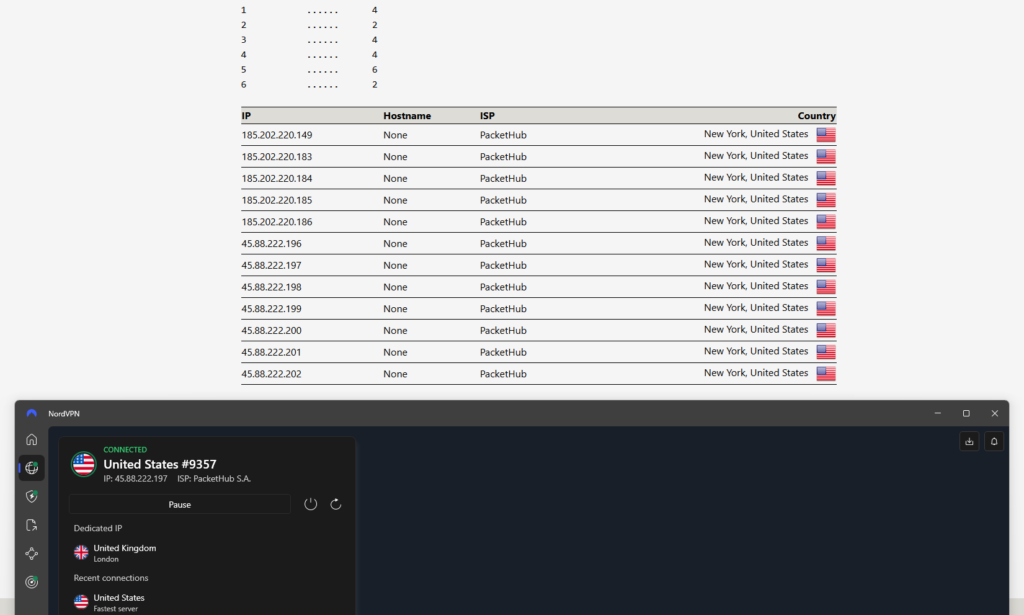
When testing a VPN provider’s privacy, I also consider it important to assess the software for IP, DNS, and WebRTC leaks. These leaks allow your IP address, DNS requests, or IP address via WebRTC to slip through the VPN connection, exposing your true location. That’s why I tested NordVPN and Proton VPN using Browserleaks.net, vetting both services for any leaks that could give away my real location during my test circuit.
Fortunately, both VPNs passed without any problems, ensuring my location remained hidden. While this made it a close tie between the two providers, I ultimately gave the win to NordVPN due to its strong audit track record. With more audits under its belt, all from Big Four firms like Deloitte and PwC, NordVPN edged ahead.
Proton VPN vs NordVPN features comparison
While Proton VPN includes all the security essentials and some advanced features, NordVPN provides a much larger array of tools. Both providers offer Double VPN, secure and proprietary protocols, and split tunneling, but Proton VPN lacks equivalent features like Smart DNS and RAM-only servers, and it’s also missing advanced security features offered by NordVPN.
During my tests, I conducted a full analysis of all features offered by both VPN services. This was partly to gauge the value for money provided by each, but also to assess which VPN offered more robust security and privacy. Overall, NordVPN can do everything that Proton VPN can do, though Proton VPN offers port forwarding and Secure Core servers.
| Feature | NordVPN | Proton VPN |
|---|---|---|
| No-logs policy (audited) | ✅ Yes | ✅ Yes |
| Kill switch | ✅ Yes | ✅ Yes |
| Split tunneling | ✅ Yes | ✅ Yes |
| Double VPN | ✅ Yes | ✅ Yes |
| Tor over VPN | ✅ Yes | ✅ Yes |
| Custom DNS | ✅ Yes | ✅ Yes |
| Obfuscated / Stealth servers | ✅ Yes | ✅ Yes |
| Ad & tracker blocker | ✅ Yes | ✅ Yes |
| Proprietary VPN protocols | ✅ Yes (NordLynx, NordWhisper) | ✅ Yes (Stealth) |
| Smart DNS | ✅ Yes | ❌ No |
| RAM-only servers | ✅ Yes | ❌ No |
| Dedicated IP option | ✅ Yes | ❌ No |
| Streaming-optimized servers | ✅ Yes | ❌ No |
| SOCKS5 Proxy | ✅ Yes | ❌ No |
| Secure Core servers | ❌ No | ✅ Yes |
| Port forwarding | ❌ No | ✅ Yes (Premium) |
Specialized Servers
NordVPN and Proton VPN both have specialized servers, but they largely benefit different types of users. With NordVPN, I tested Double VPN, Onion over VPN, P2P, Dedicated IP, and obfuscated servers – I found that it was a solid choice for streaming, torrenting, and bypassing geo-blocks on restricted sites.
Proton VPN focuses more on privacy-first server types, like Secure Core (multi-hop routing through privacy-first servers) and Tor over VPN options. I found that Proton VPN’s options lean more toward better privacy and anonymity. At the same time, NordVPN is a good option for both privacy-conscious users and those who want reliable access to geo-restricted sites.
Kill Switch
Both NordVPN and Proton VPN include an automatic kill switch that will cut your internet access on the installed device if your VPN connection drops out. This stops data leaks that can reveal your location mid-activity. To ensure there’s no risk of your location leaking, I tested both providers’ kill switches across all platforms.
NordVPN offers a kill switch on Windows, macOS, iOS, Android, and Linux, with the choice to protect specific applications or cut your entire connection. Proton VPN includes a system-wide kill switch on Windows, macOS, iOS, Android, and Linux. What’s more, the built-in “always-on VPN” setting ensured that my VPN attempted to reconnect as soon as my internet connection was restored, preventing my true IP from being exposed.
Split Tunneling
NordVPN and Proton VPN both offer split tunneling, allowing you to choose which apps use your VPN connection and which use your regular, unprotected internet connection. Segregating your internet traffic in this way can help keep speeds up, especially on slower networks. Plus, it prevents your day-to-day websites and apps from being geo-blocked if you use an international VPN server.
During testing, I noted that NordVPN provides split tunneling on its apps for Android, Android TV, and Windows, as well as a browser extension – but not on Apple-owned devices like iPhones and Macs, due to operating system (OS) restrictions. Proton VPN similarly offers split tunneling for all of the same devices, plus a browser extension, making this a fairly even tie based on my extensive tests with each OS.
Ad & Malware Blocker
NordVPN’s Threat Protection suite is adept at blocking ads, trackers, and malware – it even detected and blocked malware in files that I downloaded during my tests (so long as you’re using the Windows or Mac apps). This adds an extra layer of protection on top of your encrypted VPN connection.
Proton VPN features NetShield, a tool that can block ads, trackers, and malware-infected websites before they load, thereby protecting your device from potential risks. However, I noted that it doesn’t have the same file-scanning functionality as NordVPN, and it lacks other services, like dark web protection and credit and identity monitoring.
Meshnet (device linking)
NordVPN’s Meshnet is a unique feature that allows you to link multiple devices via encrypted connections securely. It’s suited for situations such as remote file sharing, device access, and gaming on a LAN network. Best of all, it’s free to use on up to 50 devices – even without an active VPN subscription. Proton VPN doesn’t currently have an equivalent feature like Meshnet, so NordVPN was clearly the more impressive provider in this regard.
Obfuscation
NordVPN offers obfuscated servers that can help bypass strict censorship and VPN-blocking network filters. These servers disguise your VPN traffic to look like regular HTTPS traffic. They’re suited for countries like China, which inherently block VPN traffic, and I found them adept at bypassing strict network blocks in places like educational institutions.
Proton VPN’s proprietary Stealth protocol achieves a similar effect, disguising your VPN traffic without requiring specialized servers. Both work well, but while NordVPN gave me the option to select obfuscated servers during my tests, Proton VPN handled it automatically when Stealth was selected as my primary protocol.
Multi-hop routing
Both NordVPN and Proton VPN support multi-hop connections for added privacy. NordVPN refers to this as Double VPN, routing your traffic through two VPN servers in different locations. Proton VPN’s Secure Core works similarly. However, it uses a private server that is always located within a privacy-friendly country, like Switzerland, before exiting through a second VPN server. Proton’s Secure Core helps guarantee privacy and is generally better suited for high-risk situations involving sensitive information, such as those of political dissidents.
Should I choose NordVPN or Proton VPN for torrenting
Using a VPN for torrenting is essential because it protects you from the risks inherent in peer-to-peer file sharing. When you torrent, your IP address is exposed to everybody in your torrent swarm – all of the people with whom you share files. This leaves you vulnerable to tracking, DDoS attacks, ISP throttling (when your ISP slows down your internet speed), and even legal trouble if you’re downloading copyrighted materials – something I strongly advise against.
However, when you connect to a torrent client using an active VPN connection, your IP address is shielded, and these risks are minimized. So, I tested both NordVPN and Proton VPN to check whether they effectively hide your IP while torrenting, while still offering fast enough speeds to share files quickly.
| P2P specifications | NordVPN | Proton VPN |
|---|---|---|
| Allowed on | ✅ All servers, unrestricted | ✅ P2P servers only (paid plans) |
| Free SOCKS5 proxy | ✅ Yes | ❌ No |
| Split tunneling | ✅ Yes (Windows, Android, Android TV) | ✅ Yes (Windows, Android, macOS, Linux) |
| Port forwarding | ❌ No | ✅ Yes (paid plans) |
NordVPN makes torrenting simple by automatically redirecting any detected torrent traffic to a P2P-optimized VPN server, which can improve speeds. There’s also a free SOCKS5 proxy, suited to users with slower connections. While it doesn’t encrypt your data like a VPN, it’s faster and can offer a middle-ground protection that doesn’t slow your torrenting speeds.
Proton VPN supports torrenting but only on select servers, which are indicated by a double arrow symbol against each relevant server in the server list. What’s more, this feature is only available to premium users. As I found during my tests, torrenting on the free plan will block your connection, usually after a warning message.
Our verdict:
Both NordVPN and Proton VPN support secure, IP-cloaked torrenting with the speeds needed to facilitate high-speed data transfer. However, my tests revealed that NordVPN consistently beats Proton VPN on average download speeds, as well as supporting P2P file sharing on all its servers. Proton VPN limits torrenting to paid plans and specific servers, and your speed may be poorer if you attempt to torrent on another server.
Is NordVPN faster than Proton VPN for streaming?
I put both NordVPN and Proton VPN through comprehensive speed tests using Ookla Speedtest to benchmark performance. First, I tested my baseline connection at around 500 Mbps, before connecting to each VPN in turn across 10 international VPN servers. I chose servers located around the world so that I’d get an average speed that took geographical service distance into account – some VPNs lose speed over distance.
The results showed that NordVPN is faster than Proton VPN overall. During these tests, NordVPN achieved an average download speed of 468 Mbps, while Proton VPN averaged 429 Mbps download speeds. Both of these results are more than sufficient for streaming in HD and 4K quality without lag, but NordVPN clearly came out on top.
Besides speed, I also tested which streaming services each provider could unblock. Streaming platforms around the world use geographical restrictions to limit access to them, as they need to adhere to their licensing agreements. Here are the results of my tests:
| Streaming service | NordVPN | Proton VPN |
|---|---|---|
| Netflix | ✅ Yes | ✅ Yes |
| BBC iPlayer | ✅ Yes | ✅ Yes |
| ITVX | ✅ Yes | ✅ Yes |
| Disney Plus | ✅ Yes | ✅ Yes |
| Amazon Prime Video | ✅ Yes | ✅ Yes |
| Hulu | ✅ Yes | ✅ Yes |
| HBO / HBO Max | ✅ Yes | ✅ Yes |
| BBC iPlayer | ✅ Yes | ✅ Yes |
| ITVX | ✅ Yes | ✅ Yes |
I was impressed to see both providers effortlessly bypass Netflix’s strict anti-VPN blocks that defeat lesser providers’ software by detecting VPN traffic. With powerful privacy and obfuscation features, NordVPN and Proton VPN allowed me to easily bypass blocks and watch Netflix US from anywhere in the world.

Our verdict:
Both NordVPN and Proton VPN are well-suited for streaming internationally, as both providers could unblock every streaming service that I tested. However, NordVPN’s SmartDNS feature allows you to stream on devices that don’t support native VPN applications – something Proton VPN is lacking. This feature, combined with lightning-fast speeds, gives NordVPN an edge as the best streaming VPN.
Which VPN is easier to use: NordVPN or Proton VPN?
NordVPN and Proton VPN are roughly equal in terms of device compatibility, providing apps for both mobile and desktop devices with similar operating system support. Both also support manual router setup so that you can cover all of a household’s devices without countless individual installations. Here’s an overview of compatibility:
| Device compatibility | NordVPN | Proton VPN |
|---|---|---|
| Dedicated applications | Windows, macOS, Linux, Android, iOS | Windows, macOS, Linux, Android, iOS |
| Other applications | Amazon Fire TV & Fire Stick, Android TV, Kodi add-on | Amazon Fire TV & Fire Stick, Android TV, Chromebook |
| Browser extensions | Chrome, Firefox | Chrome, Firefox |
| Router support | Routers | Routers |
| Simultaneous connections | 10 | 10 |
Installing both VPNs was straightforward and took just a couple of minutes. NordVPN’s setup felt particularly beginner-friendly, though, with clear prompts and a sleek interface from the start. One feature I appreciated during testing was its interactive server map — you simply click a country’s pin to connect, which makes choosing a location feel far more intuitive.
Meanwhile, Proton VPN takes a more traditional, list-based approach. It felt less flashy, but it’s very clean and easy to use. I also found Proton VPN’s “Profiles” feature particularly useful. It lets you save connection settings, like server, protocol, and features (like Secure Core or NetShield) into dedicated profiles that you can switch between depending on what you’re doing — gaming, torrenting, or streaming.
Our verdict:
NordVPN and Proton VPN are both easy to install and have a broad spread of polished apps for all major operating systems. NordVPN’s setup feels slightly more polished and beginner-friendly, but Proton VPN stands out with its excellent “Profiles” feature, which lets you save and switch between custom setups with ease. For visual flair and simplicity, NordVPN takes the edge, but for privacy-based customization, Proton VPN’s design impresses.
NordVPN vs Proton VPN Reddit comparison
As part of any VPN assessment, I review Reddit feedback due to the huge amount of user opinions shared on the platform. While users may differ in their preferences, the question of NordVPN vs. Proton VPN seems to lean toward NordVPN being the overall better provider. Reddit feedback agrees that NordVPN excels in speed and server reliability, while Proton VPN’s port-forwarding feature is a useful boon to have, but at a higher long-term price.
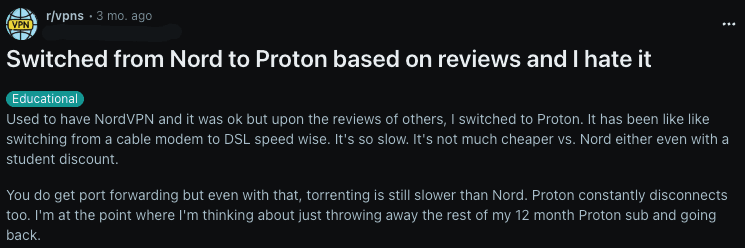
Reddit agrees that NordVPN’s speed and server availability tends to be better, with less frustrating disconnects. Other users have also commented that despite Proton VPN being cheaper in the short term, NordVPN’s long-term pricing offers better value for money. This isn’t just due to the cost of subscriptions, but also the fact that NordVPN offers a broader list of features, such as Meshnet, a comprehensive Threat Protection suite, and overall, more pleasing ease of use.
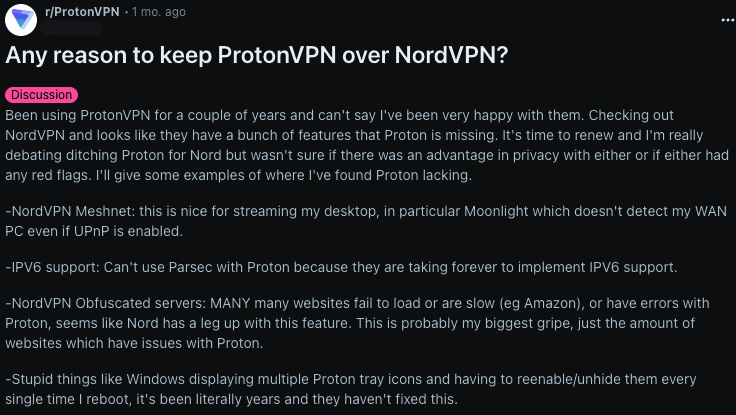
In summary, while the debate between Proton VPN and NordVPN is a heated and close race, NordVPN emerges as the overall best VPN, according to Reddit. This echoes the test results that I saw while thoroughly vetting each provider on speed, security, and features.
Final verdict: is Proton VPN better than NordVPN in 2026?
NordVPN and Proton VPN are both powerful VPN services that compete closely in key areas, like providing a vast server network, advanced security features, and the ability to bypass geo-blocks on a range of websites. However, my tests revealed that NordVPN is the overall better solution, as it offers faster speeds and provides enhanced security tools that are absent from Proton VPN.
| When to choose NordVPN? | When to choose Proton VPN? |
|---|---|
| ✅ When you want the fastest speeds and stable, reliable connections | ✅ When you want to access a larger worldwide server network |
| ✅ When you want specialty servers for streaming, double VPN, or obfuscated connections | ✅ When enhanced privacy is top priority, with Secure Core and Tor over VPN server connections |
| ✅ When you want an intuitive, polished app with an interactive server map | ✅ When you want more control over privacy, with customizable profiles |
| ❌ When you want a short-term subscription (Proton VPN is $9.99 for 1 month, while NordVPN is $12.99) | ❌ When you want a long-term subscription (NordVPN’s 2-year plan is $3.39/month, over Proton VPN’s $3.59/month and awards 3 months extra free) |
- Pricing: Proton’s 1-month ($9.99/month) and 1-year ($3.99/month) plans are cheaper than NordVPN ($12.99 and $4.99 respectively), but NordVPN provides the cheapest 2-year plan at $ 3.49/month, with 3 months extra free.
- Device connections: Both NordVPN and Proton VPN allow up to 10 simultaneous connections under a single account.
- Server network: Proton VPN offers a larger number of servers, with 20700 servers in 149 countries, while NordVPN has 8900 servers in 149 countries.
- Speed: NordVPN offers faster speeds, averaging 468 Mbps during my tests, compared to Proton VPN’s 429 Mbps average result.
- Torrenting support: Both VPNs support P2P file sharing, but NordVPN’s dedicated P2P servers and faster speeds make it the better option for frequent torrenting.
- Streaming: While Proton VPN and NordVPN can both unblock every streaming site I tested, NordVPN offers faster speeds and more reliable, uninterrupted streaming connections.
- Privacy and security: Both VPNs have robust no-logs policies and security essentials like encryption and a kill switch, but NordVPN has a more comprehensive Threat Protection that overperforms Proton VPN’s NetShield feature.
NordVPN excels above Proton VPN in 2026 due to faster speeds, a superior feature set, and more reliable connections for unblocking and streaming. While Proton VPN is a cheaper VPN for short-term subscriptions, NordVPN is more affordable on long-term plans and offers overall better value for money.

| 💵 Price | From $ 3.49 a month |
| 📱 Operating systems | Windows, Mac, iOS, Android, Linux |
| 💻 Connections | 10 |
| 💳 Payment methods | Sofort, Cryptocurrency, Credit card, Other |
| 🔒 Protocols | OpenVPN, IKEv2, WireGuard, NordLynx |
| 📅 Money-back guarantee | Money-back guarantee, 30 Days |
| 📋 Logs | Zero logs |
| 🌎 Servers in English | United States, Canada, United Kingdom, Ireland, New Zealand, Australia |
| 📥 Torrent options | |
| 🍿 Netflix | |
| 🏠 Website in English | |
| 📲 App in English | |
| 🎧 Customer Service in English | |
| 🎬 Works with |


|
If you’d like to know how NordVPN stands up against other VPN services, you can read my colleagues’ comparisons below:
- NordVPN vs Surfshark
- Surfshark vs Proton VPN
- NordVPN vs CyberGhost
- Private Internet Access vs NordVPN
- NordVPN vs ExpressVPN
- PIA vs NordVPN
- Mullvad vs NordVPN
- Proton VPN vs Mullvad VPN
- NordVPN vs ExpressVPN vs Surfshark VPN
- NordVPN vs Norton VPN: which VPN is better in 2026
- Key differences between IPVanish and NordVPN
- Differences between PureVPN and NordVPN
- Bitdefender VPN or NordVPN
- Is NordVPN better than Mozilla VPN
- Windscribe vs NordVPN comparison
FAQ
Yes, unlike NordVPN, Proton VPN offers a free plan with unlimited data, an integrated secure mail service (Proton Mail), and a port forwarding feature. However, NordVPN also offers features that Proton VPN does not have, including comprehensive malware, tracker, and malicious site protection, Meshnet, dark web, and identity theft monitoring, SmartDNS, double VPN, a password manager, and secure cloud storage.
Yes, NordVPN is better than Proton VPN’s free version, as the free tier of Proton VPN limits your server choice, offers slower speeds, and lacks advanced security features. A fairer comparison would be NordVPN vs Proton VPN Premium – but even in this case, NordVPN excels by offering a wide range of security features that Proton VPN lacks. Overall, NordVPN is the better service and offers greater value for money.
NordVPN is faster than Proton VPN, with NordVPN achieving average download speeds of 468 Mbps on my baseline 500 Mbps connection during tests, while Proton VPN averaged around 429 Mbps. My tests compared the premium versions of both VPNs, and you may get lower speeds if you’re using Proton VPN free.
Proton VPN excels in its privacy features and offers a comprehensive free tier without data limits, while NordVPN provides a wider variety of security features, faster speeds, and proprietary VPN protocols that help safeguard your privacy. While both VPNs are closely matched in a lot of areas like unblocking power and privacy protections, NordVPN excels as the better overall VPN.