

Catfishing is a dangerous form of online deception where someone pretends to be a different person than they actually are. The goal is to start a relationship with the victim and, for example, get money, nude photos or private information.
What you’ll learn in this article:
- What is Catfishing and why do people do it?
- How do I recognise the signs of catfishing?
- What should I do when I am being catfished?
Read the extensive article down below.
With the rise of social media and online dating in the past decade, catfishing has become more common than ever. The Federal Trade Commission reported that 64,000 Americans fell victim for romance scams (which often involve catfishing) in 2023. The total financial loss from these scams was a whopping $1.14 billion.
With the rise of AI, catfishing will become harder to detect and catfishing scams will become an increasing problem. So, what are the signs you are being catfished? And what should you do to prevent it if you have already fallen victim? We will answer all these questions in this extensive article.
What is Catfishing?
Catfishing is the adoption of a false online identity online to deceive someone. A catfish uses a fake profile to contact people online. To do this, the catfish usually uses made-up stories and fake photos to support their false identity.
A catfish abuses people who are looking for love or friendship online. The catfish tries to gain the victim’s trust and make him or her fall in love. Often a catfish tries to get the victim to transfer money.

Is catfishing illegal?
Catfishing does not have to be illegal, but in some cases, it can result in criminal charges. If a catfish misuses someone else’s personal information to commit fraud, there may be legal consequences. Fraud and impersonation are illegal.
Depending on the situation, other criminal offenses may also apply. Stalking or threatening is often also part of catfishing. These, too, are criminal offenses under various states and federal laws. The exact criminality depends on the specific situation, circumstances and facts. For legal advice it is important to consult a legal expert.
Why do People Catfish?
There are many different reasons people catfish. Some are more “innocent”:
- Some people catfish because they feel lonely or underappreciated in society. Their goal often is merely to create an online persona to attract people they feel wouldn’t be interested in them in real life.
- Some people catfish just because they feel they’re getting very limited romantic attention. An insecure person puts the picture of a handsome stranger on his or her profile to be more easily liked or to appear rich or “cool”.
However, catfishes often have much more sinister motives:
- Anonymous bullying: Catfishing can be used to get nude photos or other (embarrassing) information to use to bully someone. This bullying can also take place online.
- Online stalking: Someone can create a fake profile to stalk victims online. For example, a jealous ex may catfish for revenge. In some cases, catfishing can even lead to or be a part of even more severe forms of abuse.
- Identity fraud: Catfishes may create fake profiles to get private information from their victims. They can use this information to steal the victim’s identity and hack an account, for example.
- Scam: Many catfishes end up scamming their victims for money. They will often come up with excuses to ask for financial help. They might tell the victim they need money to go and see them. Or maybe a family member is ill, and they need some money to cover medical costs.
- Sextortion: A catfish may collect sexually explicit images of the victim and threaten to make them public. The catfish may demand money or force the victim to perform even more sexual acts in order not to make the explicit images public.
How Does Catfishing Work?

Catfishing usually follows the steps below:
- The catfish creates a fake account and adds fake photos and friends to make the profile look real and get the interest of the victim.
- The catfish makes contact with the victim out of the blue. The catfish usally does this via social media or a dating site.
- The catfish sends fake photos and and fake messages and tries to attract interest from the victim. The catfish will make up an excuse not to initiate a video chat.
- The catfish gives compliments and capitalizes on the victim’s hobbies and interests. The victim really gets the feeling that the catfish cares about him or her.
- If the victim trusts the catfish, the victim is often taken advantage of. Often money or personal information is taken from the victim. Sometimes the catfish asks for nude photos. These can later be used to blackmail the victim.
Threats Increase: The Rise of AI
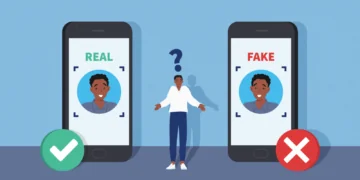
The rise of advanced AI technology is making it increasingly easy to create convincing fake profiles with unique AI-generated photographs. These photos are very difficult to distinguish from real ones.
Videos can also be generated by AI to look real. These so-called deepfakes can be used by scammers to impersonate someone else. The catfish can use a deepfake to fake a complete personality or pretend to be a celebrity. A familiar face will make the victim more likely to trust the catfish and easier to manipulate.
Scammers also use generative AI chatbots such as ChatGPT to have convincing conversations with victims in different languages. In addition, the use of AI robocalls is also becoming more common. These AI-driven automated phone calls can mimic real human voices. This will make the phone call sound legitimate and trustworthy, enticing victims to give away personal information or money.
It is important to stay up to date with the latest AI technologies. This can help you avoid becoming a victim of AI catfishing. When you understand how AI is used to create fake profiles on dating sites and manipulate online conversations you won’t be as likely to fall into the trap.
Where Can I Get Catfished?
Catfishing mainly takes place on social media platforms and online dating sites or apps. Apps like Tinder, but also social media channels like Instagram and Facebook are actively used to scam people.
The catfish manages to play on feelings, establish a bond of trust or even create feelings of love. Once the catfish has the victim’s trust, he will take advantage of it.

Below, we discuss some of the most common “catfishing platforms” and what this scam looks like on these platforms.
Tinder catfishing
The “Tinder Catfish” is one of the most common species of catfish. Once the catfish has ‘matched with their victim’, they will message them and try to gain their trust. This is when the catfishing cycle begins.
Sometimes scammers pretend to be celebrities on dating platforms. They post a picture of the celebrity on the dating app and make the victim think they are speaking directly to the celebrity. With these celebrity romance scams, scammers try to take money from victims.
Fortunately, Tinder has introduced photo verification. Tinder users must upload a video snapshot and a photo of a valid ID to prove that they really are who they say they are. After verification, users get a blue checkmark. This should make it much more difficult for catfishes to find their “catch.”
Catfishing on Facebook
Facebook catfishing generally starts with sending a friend request to the victim. Sometimes the catfish sends a direct message, hoping the victim will answer. Once the victim responds, the perpetrator will reel them in with sweet-talking and fake stories. There are quite a few other Facebook scams out there, so it’s best to remain up to date and arm yourself.
Instagram Catfishing
With a platform as visually orientated as Instagram and more than a billion users, Instagram catfishing can hardly be avoided completely. Catfishes can send their victim either a follow request or a direct message using Instagram Direct. The latter will appear as a message request and has to be approved by the victim.
Instagram is no stranger to profiles that (seemingly) belong to the rich, successful, and beautiful. Therefore, anyone can come into contact with someone that seems to be a little bit too good to be true and will eventually turn out to be a catfish. This is just one of many Instagram scams you should know about.
Platforms for Children
Although most catfish target the 40- to 65-year-old age group, more and more catfishes are also targeting an even more vulnerable demographic: children. Teenagers in particular are increasingly becoming victims of a catfish. An adult male who pretends to be a 15-year-old teenager online, for example, and in this way establishes a trusting relationship with the victim.
On platforms such as Roblox and Minecraft, children can easily come into contact with adults who have wrong intentions. More than once, young children and teens become victims of grooming. This is an online form of child grooming with the ultimate goal of sexual contact. Adults can also impersonate peers and ask children to share nude photos. This can lead to blackmail and sextortion.
It is therefore advisable for parents to educate their children about Internet safety. For example, tell your children never to send (intimate) photos, especially to strangers, and not to arrange meetings with contacts they have met online.
9 Signs You Are Being Catfished

Catfishes are generally excellent at tricking their victims. They rely on the emotions of affection and infatuation to cloud their victim’s judgment.
Nevertheless, there are usually a few clear warning signs you are being catfished:
- Avoiding (video) calls
- No online presence
- Very few friends or followers
- Recently created profile
- ‘Professional’ photos
- Stolen photos
- Fake photos
- Asking for money
- Asking for explicit photos or videos
We will go over these red flags below and elaborate on each of the signs.
1. Avoiding (video) calls
Catfishes want to avoid situations where their true identity is exposed. Therefore, they’ll never agree to a video chat or to meet up in person. Often, they won’t even accept a regular call (without video). After all, even their voice could expose information they don’t want you to know, such as them being a man instead of a woman or vice versa.
Therefore, if someone you met online has constant excuses not to meet up or have a (video) call, this should be a definite red flag for catfishing.
AI warning:
Scammers can use deepfake faces in video chats. These fake videos are almost indistinguishable from the real thing. If the mouth makes unnatural movements and the speaker does not blink his eyes, then you may be dealing with a deepfake.
2. No online presence (on other platforms)
A large part of our presence is online these days. Therefore, you can expect someone active on one social platform to also be active on others. This is even truer when we focus on a younger demographic, where catfishing is rampant.
If the person you just met has a very lacking online presence, ask yourself why. Especially when combined with other signs, this might just be a red flag.
3. Very few friends or followers
When someone approaching you online has very few friends on Facebook or followers on Instagram, this could be a red flag for catfishing.
A profile with few posts or many followers but few real responses or interaction can also be a sign of a catfish.
4. A very recently created profile
If a social media profile was very recently created, this could be a red flag. This is especially something to look out for if a profile does have a decent number of friends or followers, but something still seems “fishy.”
A recently created profile could just mean someone is genuinely new to a social medium. But it could also mean they frequently create fake profiles to find new victims to catfish. After all, once a profile is flagged or reported on a social medium, it’s often removed. As such, catfishes often create many fake profiles, either one after another or simultaneously.
5. “Professional” pictures
Another huge giveaway that something’s off is if your romantic interest only has professional-looking pictures on their profile. Most people on social media — celebrities and influencers excluded — mainly upload pictures taken by family and friends and some selfies.
If you encounter a profile full of professional-looking pictures, this might be either a sign they’re using someone else’s photos (more on this later), or they went through great effort to make themselves look better than they really are. In both instances, it’s wise to ask yourself why.
Even if they are their real photos, it’s probable someone’s trying to lure you in with excessively flattering pictures. Of course, plenty of (aspiring) models promote themselves on social media, but how many of those approach random strangers online out of romantic interest?
6. Stolen pictures
Needless to say, the use of stolen pictures online is an even more serious sign of malicious intent than using stock, professional photos. If someone is using stolen pictures, it’s very likely they are out to scam you. After all, scamming people on social media is one of the most common reasons for creating fake accounts.
Fortunately, it’s often quite easy to find out whether someone is using stolen pictures on social media. You can simply use Google Lens to do a reverse image search to find similar pictures like the one used by your (potential) catfish and find out where they come from.
To do this, simply go to Google Images and click on the little camera icon to upload a picture or paste a picture’s URL and start your search.

AI Warning
AI-generated photos cannot be found through Google Lens search. So always be alert! Faces created by AI can sometimes be recognized by details that are incorrect such as color differences at the edges of the face and wrong shadows. Below we will tell you more about these fake photos.
7. Fake photos
AI allows catfishes to easily manipulate photos. AI programs generate photos that are almost indistinguishable from the real thing. The tips below can help spot the fake photos:
- Look at the hands: AI programs are not good at generating realistic hands. For example, a hand sometimes has six fingers.
- Look at the eyes: AI often places strange shadow shapes in the middle of the eye.
- Look at the teeth: AI often has trouble generating teeth.
- Check shadows: AI has trouble mimicking light and shadows.
- Use a tool to spot fake photos such as AIorNot.com.
The photo below is from the website ThisPersonDoesNotExist.com. This site displays photos of people who do not exist. The photos are generated with AI. When you click refresh, the website keeps showing a new face.
These appear to be real photos, but if you look closely, you can sometimes spot “flaws”. See the teeth and ears of the woman in the photo below:

8. Asking for money
This is one of the most obvious signs you’re dealing with a catfish. After all, a common reason for catfishing people is to come up with excuses to ask them for money down the line. Ask yourself: How likely is it that you would ask someone you just met online for money, especially if you’re hoping to have a relationship with them?
9. Asking for explicit pictures or videos
Asking for explicit pictures or videos can be a huge red flag. This could mean the asker is trying to combine catfishing with another dangerous form of cybercrime: sextortion. In this scenario, catfishing is actually used to obtain sensitive images of you, which will later be used as leverage to extort you into providing more images or paying the “sextorter.”
AI warning
Deepfake technology allows someone to take fake nude photos or fake porn without asking permission. Deepfake videos are increasingly easy to make. To make a good deepfake video, the catfish needs several clear photos of your face.
So to avoid becoming a victim of deepfakes, it is advisable to post and share as few photos of yourself online as possible.
What (Not) to Do When You’ve Been Catfished
We obviously hope that by studying and recognizing the above catfishing signals, you will stay safe online. However, anyone can get unlucky or have a momentary lapse of judgment. Therefore, we offer you some steps to go through if you’re a catfishing victim below. These steps will not undo your experience, but hopefully they will mitigate some of the damage and help others stay safe(r) online.
Important:
- Don’t give the catfish any money. If you gave them money in the past, stop doing so.
What to do:
- If you have given them money, call or contact your local police department so they can start an investigation. In some cases, people got their money back this way. After all, obtaining money from victims this way is a form of cyber fraud. Go to the Europol website to find out how to report cybercrime if you live in Europe (the UK included). If you live in the US you should file a complaint with the FBI’s Internet Crime Complaint Center.
- Block the catfish from your social media accounts and stop contacting them.
- Report the catfish on the website or platform where you met them.
- If the catfish scammed you, it can’t hurt to help others stay safe by reporting it to a scam tracker, such as the one operated by the Better Business Bureau.
Finally: follow Your Instinct
Are you in contact with someone online and something does not feel right? For example, is the person in question asking for money, personal information, or are all his or her social media profiles created on the same date?
If so, push for a video chat right away. Does a video chat conversation (or a real meeting) never turn out to be possible and you end up feeling guilty every time? Then you’re probably being played and it’s best to cut off contact immediately.
With the improved AI techniques, it is easier to trick someone online with fake profile pictures and AI-generated interactions. Stay skeptical and realize that with AI nothing is what it seems!
For more cyber safety tips, read our guide to avoiding online scams.
Do you have a specific question about catfishing you want answered straight away? Check out our frequently asked questions about this topic down below. Simply click on a question to see the answer. Is your question not there? Leave a comment and we’ll get back to you as soon as possible!
Catfishing is an online malpractice that involves deceiving a victim by pretending to be someone else than you actually are. The catfish will make the victim fall in love with them, with fake pictures and stories about how great they and their lives are. Once the catfish has the victim’s trust, different things can happen. Often, the perpetrator will ask the victim for money, using a crafty fake story.
There are many possible warning signs for catfishing. Three very common signs of catfishing are the following ones:
- Avoiding video calls and face-to-face meetings
- Using stolen pictures
- Asking for money
Catfishing is an increasingly common phenomenon: in 2023, 64,000 US citizens reported being a victim of romance scams (which often involve catfishing).
The damages resulting from catfishing are also enormous: about $1.14 billion in 2023. The actual amount (unreported cases included) is likely much higher.
The signals of Instagram catfishing are quite similar to other types of catfishing. Instagram is a very visually orientated profile and on the catfish’s prfoile you will undoubtedly find many glamorous photos. We recommend verifying if these are real by doing a quick Google Lens image search. It is also advisable to look critically at your privacy settings on Instagram.



The guy that I am very interested in. I know is being catfish by a woman for the past year and a half.. he says that he loves her, but she has never once made an attempt to see him. There’s always an excuse to why she will not visit him, and he not be able to visit her. There’s always always an excuse. How can I help him? I have tried many things, and nothing seems to work, I do not know what she is saying to him, but whatever it is, she has him hook line and sinker. Please help.
Hi Barbara. If you fear someone you know is being catfished, the best thing you can do is to gently breach the topic with them and educate them about the topic. We realise this can be tricky, however. Whether this is an actual case of catfishing or not, it is always good to be aware of the dangers.
I think my sister is being catfished how can I go about taking to her about this I heard him ask her for a card and tell her he loves her and how sweet she is and he wants to come and see her?
That sounds very tricky indeed. It might be best to breach the topic gently, inform her about the existence of catfishers and tell her you want this to go well, but that you're worried she will get hurt and lose a lot of money. If someone she's never seen before claims to love her but needs money to see her, that is very likely a catfisher.
I was scammed over a year ago by someone on Facebook who made me fall for him and didn’t realize anything about it until afterwards. I’m ashamed to admit I fell for this person and his lies because I was ignorant of such things even tho I am an elderly person. I hate to admit I sent him a lot of money vi gift cards. At one time one of the sales person in Walmart asked if I was being scammed but I was really snowed under. I was truly naive and stupid for an old woman. I will never be so foolish in the future but I wish I had recovered my money
We're really sorry to hear that happened, Frances! Catfishers can be incredibly cunning. Thank you for sharing your story. It might just help inform someone else in a similar situation before it's too late.
Facebook is not doing anything to protect us users against these people. We have to bust a move here just to switch off the messeging requests, hide our martial status from the, and our friends lists from these catfishes to hide ourselves. Instagram has catfishes too, and when they want to follow you, you end up following them and they set their profiles as private and then then you have to wait until they approve you just to see their professional shots. Same as Google Chat, there are catfishere there, and with gmail they can be untracable. We got to do something about this, ignoring them, blocking them, and they blocking us, it just gives them lead way for them to make a new gmail, Facebook and Instagram account to go attack some more victims. These catfishes are fake bots, aliens from another world, or from another time frame. It's going to get worse over time we don't do nothing about it. We need tools and better detection in Anti Virus software to detect these fake profiles.
One more sign that you are being catfished: You’ve been having a several days or weeks of nice conversations, then you make he or she know that you are suspicious, they’ll get offended and threaten to stop talking to you. That will put you on the defensive and make you apologize and quit pursuing your doubts. Best think to do at this point? Say “ok, bye”
Hi Edgar! You're very right. Catfishing definitely includes manipulative behavior like this. A catfish will try to earn your trust and love, then use that against you.
The one I talked to would say mentally abusive things when I questioned him like that I wasn't very smart or I am stupid. In my opinion he is the one who is stupid, his story he went to work in another country, missed his flight home, had trouble on the job so he had no money to get home or access to his "huge" bank account and no one to send him money!!! That's stupid!!!!
He was a romancer and a lover believe me! Be careful out there
I think I been catfished by the girl I talked to on Bumble BFF. She was avoiding meeting face to face. We was supposed to met at Trudy’s in Austin, Texas. She ignored me when I asked for the location of the Trudy’s. So I deleted the app. I don’t appreciate people doing that to me. I deleted the app. I’m not looking for friends on the internet. I’ll go get Tex-Mex by myself.
Let me tell you they will say anything to get what they want and will make up any story to get it. So be careful and demand a real time video chat. DO NOT GIVE ANY MONEY UNDER ANY CONDITION.
if you know someone is a scammer how can you let people know? other countries have where scammer is written on their face book why doesnt US have thie
Hi Catherine! The best thing to do when you know someone's a scammer is to report them to the platform they're on (for example Facebook or Instagram). Beyond that, you can report possible scams on various scam tracker platforms, like the Better Business Bureau. This can help other people spot scammers more easily.
I was talking to someone from Ghana. I did get scammed.
Meet them on Plenty of Fish.
Thought it was too good to be true.
First it was a "I need so much for a plane ticket" then it was because they would not let her on the plane because she didn't have travel money.
So how to I report this?
That's a very common scam indeed. If you've given the scammer money, it's best to contact the local police and see what your options are for reporting the crime. Aside from that, you can use Plenty Of Fish to block and report the account (click on the three dots, then choose "Report User") to help protect others against the account. Finally, you can also report to a scam tracker, like that by the Better Business Bureau. This way, you can spread the word and help others recognize scammers more quickly. Good luck!
I've been talking to this one guy for over 2 years now. I met him on Facebook. He said he was a pilot in Amsterdam Netherlands. I've asked him to send a recent photo, says his phone doesn't work that good. And asked him to video chat and he said his phone is messed up. Now he finished his job a year ago but he says he's coming to meet me and he's getting the money to come. But he's asked me to help out with money and a new phone. He sent me a video but his voice is different on the phone. My family says he's a Scammer yet I don't believe it somewhat. He tells me loves me and can't live without me. I have deep feelings for him. I fell in love with him so quick. And I haven't even met him. He's got an accent also. I want to believe he's not one.
Hi Lisa! It does indeed sound like this could be a catfisher. Our advice would be to NOT send him money under any circumstances. That's the telltale sign that something is off. It's a good thing you're doubtful about that video, too. It sounds like he's trying to win your trust by giving you kind of what you asked for (a video) but not what you need to actually verify his identity (an actual video chat where you can talk to him directly). Definitely be careful!
Do they usually involve other members of your family? I mean texting with others in your family. How elaborate are these catfishers?
It differs, but catfishing schemes can be incredibly elaborate. Via your socials (Facebook etc.) they could possibly get in touch with your family, trying to scam them, too, all to make their act seem more genuine and real.