With the most secure VPN, you can create a secure tunnel for your online activity that encrypts your internet traffic and hides your IP address. By doing so, your data gets shielded from hackers and other third parties when using public Wi-Fi, while your real location gets masked to keep browsing private, secure, and anonymous.
However, not every VPN is trustworthy. VPNs that provide weak or outdated encryption can expose you to cyberattacks. Others can secretly log your activity data (like browsing history or IP addresses), risking your privacy under the guise of protection. Worse, free and unverified VPNs sometimes sneak in malware instead of providing security.
That’s why I tested dozens of VPNs to find only the most secure and private options. In the end, NordVPN, Surfshark, Proton VPN, IPVanish, and ExpressVPN proved to be the most secure VPN services in 2026. All five offer cutting-edge encryption, proven no-log policies, and extra tools for additional privacy, like leak prevention and kill switches, ensuring your online privacy stays intact.
Top 5 safest VPNs: shortlist
-
1.NordVPN: Overall the most secure VPN with strong privacy protection
-
2.Surfshark: Affordable and safe VPN with unlimited device connections
-
3.Proton VPN: Safest freemium VPN backed by Swiss privacy laws
-
4.IPVanish: Secure VPN with strong encryption protocols
-
5.ExpressVPN: Trusted VPN for anonymity with airtight privacy
How to choose a secure VPN?
VPNs are a valuable privacy tool for anyone who wants to enhance their online safety and privacy. However, it’s not only important to pick a reputable and reliable VPN provider, but also to understand their limitations to guarantee the best possible protection.
Here are six things to consider when choosing the most secure VPN:
- Strong encryption: a secure VPN should use military-grade encryption types that can’t be compromised, such as 256-bit AES or ChaCha20 encryption. I’ve checked which kind of encryption each VPN provider uses and only included military-grade VPNs.
- No-logs policy: the most trustworthy VPNs must never store any personal data, including data related to their services. This includes information like used IP addresses, browsing history, and also connection times.
- Reliable kill switch: in case your VPN connection unexpectedly drops, the kill switch feature automatically cuts your internet connection. This prevents any accidental data leaks.
- VPN protocols: modern and secure protocols like OpenVPN, WireGuard, or IKEv2/IPSec offer safety without sacrificing performance. That said, avoid providers that rely solely on outdated options.
- Independent audits: the best VPNs undergo regular third-party audits of their no-logs policies, encryption, and security measures to ensure your activities remain private.
- Other important factors: speed, server coverage, and the number of simultaneous connections all affect how practical and secure a VPN is for everyday use.
All these features combined separate truly secure VPNs from services that only appear safe on the surface.
With AES-256 encryption, a strict and frequently audited no-logs policy, and RAM-only servers, NordVPN safeguards your personal data and keeps prying eyes away. Combined with features like Double VPN and Threat Protection Pro, it ensures unmatched online privacy and security.

Most secure VPNs in 2026: detailed list
To find the best VPNs for privacy in 2026, I tested 25+ providers. I evaluated each service’s encryption strengths, no-logs policies, independent audits, kill switch reliability, and overall performance. In the end, only a few met strict security standards and delivered consistent protection. Below you’ll find the most secure VPNs committed to keeping you safe online.
Top 1. NordVPN – best VPN for privacy and security
Rating: 9.3 ⭐⭐⭐⭐⭐
Encryption: AES-256 and ChaCha20
No-log policy: strict and independently audited
Kill Switch: system-level and app-level kill switches
NordVPN is the safest VPN I’ve tested, offering a strong combination of airtight security and unmatched performance. During my tests, it consistently bypassed geo-restrictions on sites like Netflix and BBC iPlayer, while delivering the fastest speeds on this list of around 437Mbps.
NordVPN uses AES-256 with OpenVPN and ChaCha20 with its proprietary NordLynx protocol. You can further secure yourself with its newest NordWhisper protocol, designed to hide VPN usage and bypass network restrictions and censorship. Plus, the Perfect Forward Secrecy guarantees that your past and future sessions stay secure. Its strict no-logs policy has also been repeatedly verified by Deloitte (latest February 2025), and another audit done by Cure53 confirmed app security (March 2025). Unlike many rivals, NordVPN includes both system-level and app-level kill switches, so your data doesn’t get leaked in case your VPN connection drops.
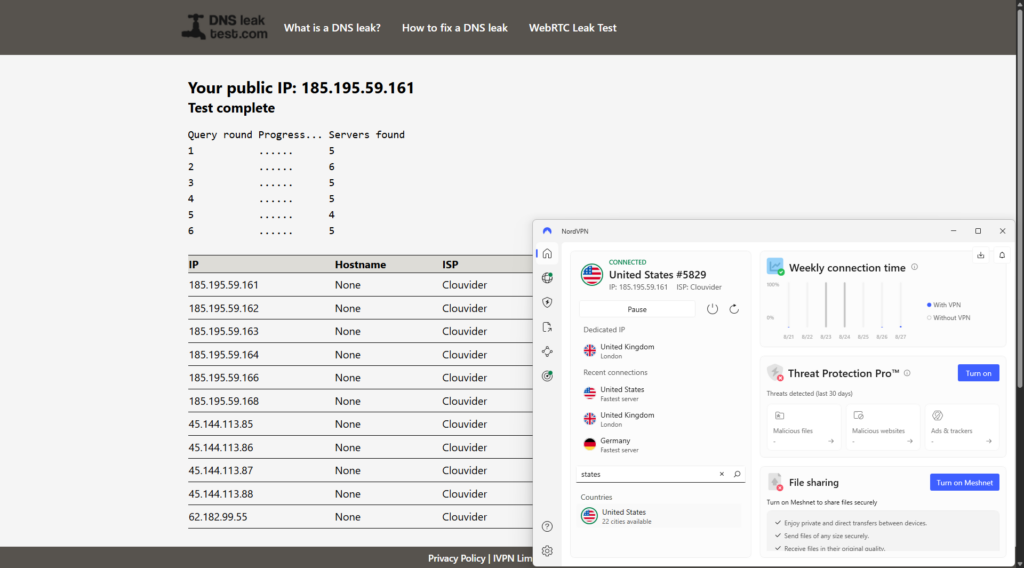
Extra protections include Double VPN, Onion Over VPN, Obfuscated Servers, DNS/IP leak protection, Threat Protection Pro (lightweight antivirus and tracker blocking), and Dark Web Monitor alerts if your credentials surface online. NordVPN works on all major platforms, and you can connect up to 10 devices at the same time.
You can subscribe to NordVPN for $ 3.49/month on a long-term plan. There’s a 30-day money-back guarantee and a 3-day free trial on Android, so you can test this private and secure VPN with zero risk.
Things I like
- Fastest speeds in my tests
- Broad and top-tier security tools like the NordWhisper protocol and Double VPN servers
- Strong encryption, PFS, and recent independent audits
- Streaming worked flawlessly
Things I didn’t like
- Only 3 days of free trial, available on Android device
Top 2. Surfshark – most secure VPN for personal use
Rating: 9.0 ⭐⭐⭐⭐⭐
Encryption: AES-256 and ChaCha20
No-log policy: strict and independently audited
Kill Switch: system-level kill switch
Surfshark is not only a safe VPN service, but it’s also one of the best affordable providers that offers strong privacy features. In my tests, it unblocked streaming platforms like Hulu and Prime Video just as reliably as NordVPN, while still delivering speeds of around 414Mbps.
It uses AES-256 for OpenVPN/IKEv2 and ChaCha20 for WireGuard, along with Perfect Forward Secrecy to protect session keys. There’s also a system-level kill switch to cut off traffic in case the connection drops. Plus, Surfshark’s no-logs policy was confirmed by Deloitte in June 2025.
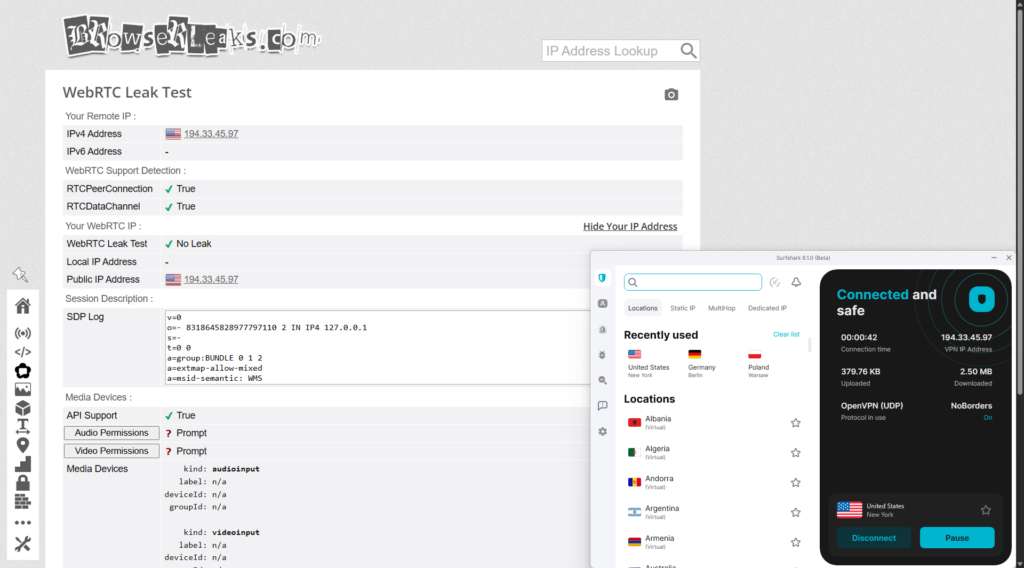
For additional security, there’s MultiHop, Camouflage Mode to hide VPN traffic, NoBorders Mode for restrictive networks, IP Rotator, and DNS/IP leak protection. Surfshark also offers GPS Spoofing on its Android app and private DNS servers to handle DNS requests and keep them off your ISP’s logs. Finally, Surfshark allows unlimited simultaneous connections across all major platforms, which makes it an ideal secure VPN for families and multi-device users.
At just $ 2.49/month on a long-term plan, Surfshark is one of the most affordable VPNs for security. There’s also a 7-day free trial, and a 30-day money-back guarantee to test this secure VPN app risk-free.
Things I like
- Unlimited device connections
- Strong speeds and reliable unblocking
- Wide set of advanced privacy tools, like Camouflage Mode, MultiHop, and more
- Excellent price
Things I didn’t like
- Based in the Netherlands, a part of the 14 Eyes alliance
Top 3. Proton VPN – free & safe VPN for protecting your data online
Rating: 8.9 ⭐⭐⭐⭐
Encryption: AES-256 and ChaCha20
No-log policy: strict and independently audited
Kill Switch: system-level kill switch
Proton VPN is one of the best free vpn services that is reliable and secure, offering strong speeds without sacrificing performance. While the free plan is limited and not great for streaming or torrenting, it’s one of the few truly free and safe VPN services for everyday browsing. While testing the Plus plan, it unblocked sites like Prime Video and Netflix with ease. Speeds were also strong, averaging around 402Mbps with VPN Accelerator enabled.
Proton VPN uses AES-256 encryption for OpenVPN and IKEv2 protocols, and ChaCha20 for WireGuard and Stealth. What sets this provider apart is that all of its apps are open-source and independently audited, while Perfect Forward Secrecy ensures that old session keys can’t be reused. Moreover, its no-logs policy was audited by Securitum (July 2024), and a SOC 2 Type II audit was done by Schellman (July 2025), confirming Proton VPN’s security practices.

For advanced protection, you will find a system-level kill switch, Secure Core servers (basically multi-hop via hardened servers), NetShield (an ad/malware blocker), Tor over VPN, Alternative Routing to bypass censorship, and DNS/IP leak protection. Plus, all Proton VPN’s servers use full-disk encryption, meaning that even if attackers gain physical access to them, they can’t expose user data.
At only $ 2.99/month for long-term plans, Proton VPN includes a 30-day money-back guarantee and a safe free version, making it one of the safest VPNs in 2026.
You can also save on long-term Proton VPN subscriptions, so if you prefer not to commit, check out the current Proton VPN coupons for available discounts.
Things I like
- Open-source apps and multiple audits
- Secure Core and full-disk encryption
- Safe free version available
- Reliable unblocking with Plus plan
Things I didn’t like
- Free servers too limited for streaming and torrenting
Top 4. IPVanish – most private VPN for anonymous browsing
Rating: 8.5⭐⭐⭐⭐
Encryption: AES-256 and ChaCha20
No-log policy: strict and independently audited
Kill Switch: system-level kill switch
IPVanish is another private and secure VPN that impressed me with its solid performance and highly customizable feature toolset. In my tests, it unblocked Netflix and Hulu easily, but it took a couple of tries to unblock Prime Video and BBC iPlayer. While slightly slower than others, IPVanish speeds were still excellent, averaging around 388Mbps – more than enough for UHD streaming.
Regarding encryption, it uses AES-256 for OpenVPN and IKEv2, and ChaCha20 for WireGuard, plus IPSec as an additional option. IPVanish’s no-logs policy has also been independently audited by Schellman Compliance in April 2025, and confirms that the service doesn’t retain user activity. Plus, to block traffic in case the VPN connection drops, IPVanish offers a system-level kill switch.
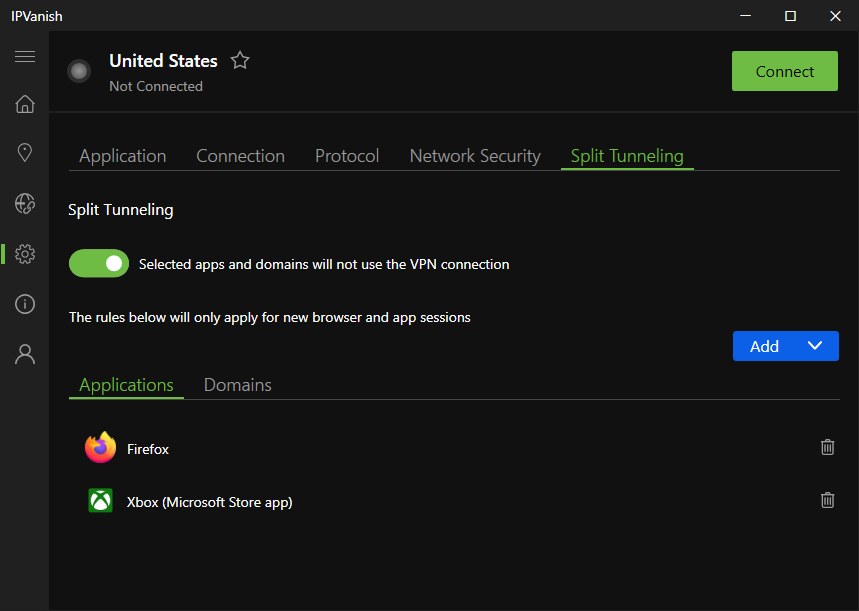
To boost security, in IPVanish apps you’ll find features like Double Hop, Scramble (obfuscation) for bypassing restrictions, DNS/IP leak protection, Split Tunneling, LAN traffic blocking, and SOCKS5 proxy support. You also get Threat Protection, and even a Link Checker and QR Code Checker. The main downside of IPVanish is that it’s US-based, but to ensure user security, IPVanish runs on fully self-owned infrastructure and maintains a Trust Center with regular transparency reports.
The IPVanish VPN price starts at just $ 2.19/month, and it comes with a 30-day money-back guarantee and a 7-day free trial (available on iOS and Android devices). Lastly, like Surfshark, it supports unlimited simultaneous connections, making it a safe, flexible, and affordable option for households.
Things I like
- Unlimited device connections
- Self-owned infrastructure for better privacy control
- Extra security tools and transparency initiatives
Things I didn’t like
- Operates under US jurisdiction
Top 5. ExpressVPN – encrypted VPN service for maximum protection
Rating: 8.5⭐⭐⭐⭐
Encryption: AES-256 and ChaCha20
No-log policy: strict and independently audited
Kill Switch: system-level kill switch
ExpressVPN offers a secure VPN app that’s reliable and very easy to use. During tests, it unblocked sites like Hulu, Prime Video, and Netflix almost instantly, all while maintaining strong speeds of around 390Mbps.
Encryption is handled with AES-256 across OpenVPN, IKEv2, and ExpressVPN’s proprietary Lightway protocol. In addition to that, ChaCha20 is supported on Lightway for lower-powered gadgets and helps preserve device battery life while maintaining strong encryption. To reinforce security, this VPN includes Perfect Forward Secrecy and in-house TrustedServer technology (RAM-only servers that get wiped with each reboot). In February 2025, KPMG did an independent audit of the no-logs claims, and its browser extensions passed a Cure53 audit in August 2024. Lastly, the Network Lock (system-level kill switch) ensures that no data gets leaked if the VPN connection drops unexpectedly.
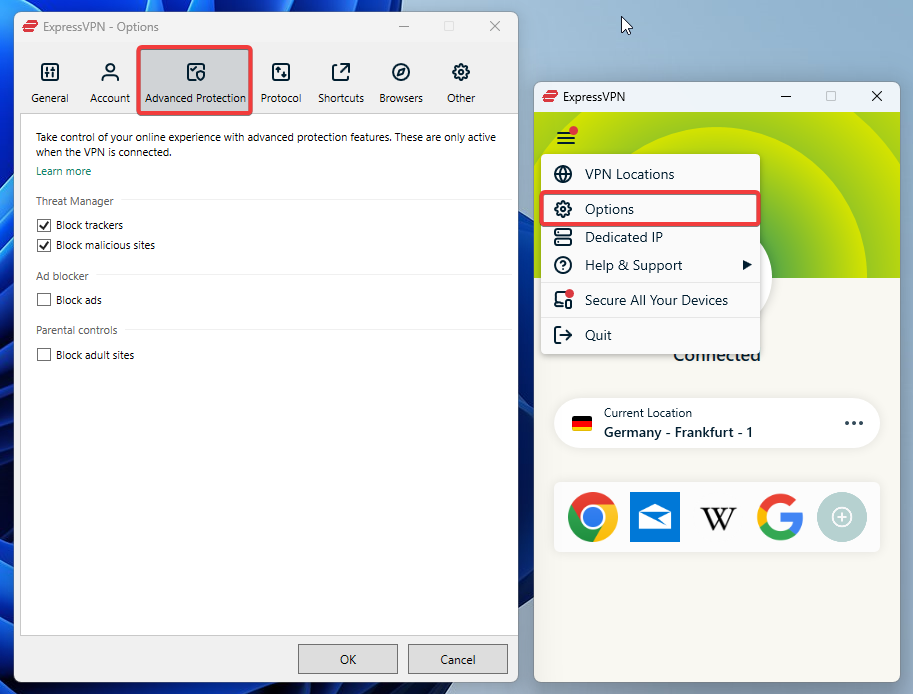
Other protections include Threat Manager to block trackers and malware, Split Tunneling, and Private DNS. I also liked that with every subscription you get access to a secure password manager, known as ExpressVPN Keys. Finally, you can simultaneously connect up to 8 devices to ExpressVPN servers.
ExpressVPN costs $ 2.99/month with a 30-day money-back guarantee on long-term plans.
Things I like
- Strong encryption with Lightway protocol
- TrustedServer (RAM-only) technology to enhance user security and privacy
- Beginner-friendly apps
Things I didn’t like
- No free trial
Compare the safest VPN services
| Most secure VPNs | Rating | Based in | Encryption | No-log policy | Kill Switch | VPN protocols | Double VPN | Ad blocker | Independent audits | Price |
|---|---|---|---|---|---|---|---|---|---|---|
| Top 1. NordVPN | 9.3 ⭐⭐⭐⭐⭐ | Panama | AES-256 encryption | ✅ Yes | ✅ Yes | OpenVPN, NordLynx, NordWhisper | ✅ Yes | ✅ Yes | No-logs policy audit by Deloitte (February 2025) and app security audit by Cure53 (March 2025) | From $ 3.49/month |
| Top 2. Surfshark | 9.0 ⭐⭐⭐⭐⭐ | The Netherlands | AES-256 and ChaCha20 | ✅ Yes | ✅ Yes | OpenVPN, WireGuard, IKEv2 | ✅ Yes | ✅ Yes | No-logs policy audit by Deloitte (June 2025) and app security audit by SecuRing (April 2025) | From $ 2.49/month |
| Top 3. Proton VPN | 8.9 ⭐⭐⭐⭐ | Switzerland | AES-256 and ChaCha20 | ✅ Yes | ✅ Yes | OpenVPN, WireGuard, IKEv2, Stealth | ✅ Yes | ✅ Yes | No-logs policy audit by Securitum (July 2024) and SOC 2 Type II audit by Schellman (July 2025) | From $ 2.99/month |
| Top 4. IPVanish | 8.5 ⭐️⭐️⭐️⭐️ | The US | AES-256 and ChaCha20 | ✅ Yes | ✅ Yes | WireGuard, OpenVPN, IKEv2, IPSec | ✅ Yes | ✅ Yes | No-logs policy audit by Schellman Compliance (April 2025) | From $ 2.19/month |
| Top 5. ExpressVPN | 8.5 ⭐️⭐️⭐️⭐️ | The British Virgin Islands | AES-256 and ChaCha20 | ✅ Yes | ✅ Yes | Lightway, OpenVPN, IKEv2 | ❌ No | ✅ Yes | No-logs policy audit by KPMG (February 2025) and browser extension audit by Cure53 (August 2024) | From $ 2.99/month |
How to test VPN security
When choosing the most secure VPN, it’s important to test and see if the provider actually protects your privacy and data. Keep in mind that not all VPNs are equal: some use weak encryption technologies, log your activities and data, or even leak your real IP address, naturally rendering the VPN useless. So, to test VPN security, pay close attention to these points:
- Check encryption and protocols: make sure that your selected VPN supports strong options, like AES-256, OpenVPN, or WireGuard. Do note that some providers have adapted the WireGuard protocol and developed their own, like NordVPN’s NordLynx, or ExpressVPN’s Lightway. Also, avoid PPTP or outdated protocols.
- Test for IP/DNS leaks: use tools like ipleak.net or dnsleaktest.com to confirm your real IP and DNS requests stay hidden.
- Look for WebRTC leaks: head to sites like browserleaks.com/webrtc to make sure that your VPN blocks this common leak.
- Test the kill switch: disconnect the VPN suddenly – if the kill switch feature is working properly, your internet should cut off immediately to prevent exposure, until you reconnect to a VPN server.
- Confirm no-logs policy: check the provider’s privacy policy and review independent audits.
With these quick checks, you can confirm if your VPN truly provides safe and secure protection for all your devices.
VPNs that failed my security tests
Some VPNs simply aren’t safe and hide behind false advertising, malicious intents, and unethical practices. A truly secure provider has to protect your data and IP address at all times, never log user activities, and never leak any identifiers. Unfortunately, during my tests, not all VPNs proved to be trustworthy and even failed to meet basic security needs. Weak or outdated encryption, IP/DNS/WebRTC leaks, vague or logging-friendly privacy policies, invasive permissions, third-party trackers, or even bundled adware – all of these are not traits of the most secure VPN and should be avoided.
The following VPN providers have proven to be unreliable. Therefore, I highly advise you to stay clear of these services:
| VPN provider | Reason |
|---|---|
| ❌ HolaVPN | Logs all your data, lets others use your bandwidth, and has malware and spyware allegations. |
| ❌ iProVPN | Multiple antivirus programs flagged the Windows client as a virus/malware. |
| ❌ Tuxler VPN | Collects a lot of user data, shares it with advertisers, and doesn’t have a kill switch. Plus, the P2P model uses your IP as an exit node. |
| ❌ BetterNet | Collects a lot of user data and sells the data from free users. Plus, it’s been found to have DNS and WebRTC leaks. |
| ❌ Hotspot Shield | Injects tracking scripts, logs user data, and shares it with 3rd parties. |
| ❌ PureVPN | Has a history of data leaks and, despite the no-logs policy, has provided user logs to the FBI. |
| ❌ VPN Gate | Tracks everything you do via the VPN and logs your real IP address. |
| ❌ Psiphon | Explicitly logs browsing history, is known for DNS leaks, and does not offer a kill switch. |
| ❌ Speedify | Logs your IP address and connection timestamps despite “no-log” marketing. |
| ❌ Hoxx VPN | Logs sensitive user information, has no kill switch, and offers outdated encryption and protocols. |
| ❌ X-VPN | Keeps logs and is based in Hong Kong. This means your data might end up with the Chinese authorities. |
| ❌ Secure VPN | Has DNS/IP leaks, does not offer a kill switch, and uses outdated protocols. |
| ❌ UltraVPN | Leaks your IP address and has a malfunctioning kill switch. Moreover, UltraVPN gathers too much personal data. |
Also, beware of cracked VPNs. Pirated versions of premium VPN software are not only illegal, but they can also carry malware that can collect sensitive data, plague your device with unwanted ads, or hijack traffic. Stick to reputable and audited providers downloaded from official sources only.
Final tips: essential VPN security features to enable
To get the highest security that the safest VPNs can provide, you first need to enable the right features. To ensure your data is never exposed, start with the auto-connect feature. This ensures your VPN automatically activates when you start your device or join any network, especially public Wi-Fi. On top of that, to prevent leaks and keep your IP hidden, always enable the kill switch to cut internet access if the VPN connection suddenly drops.
If you want an additional layer of privacy, use the Double VPN feature to route your traffic through two encrypted servers. While it may come with a small speed trade-off, it’s best when you’re handling sensitive information. Connection protocols are also important, so choose one wisely: WireGuard (or its equivalents, like NordVPN’s NordLynx) for speed and efficiency, OpenVPN for compatibility, and IKEv2 for mobile stability.
That all said, if you’re after the ultimate privacy VPN in 2026, look no further than NordVPN. With a blend of strong encryption, audited no-logs policies, and market-leading security features, it is the top choice for privacy- and anonymity-seeking users.

Black Friday offer! Get 78% OFF NordVPN + 3 months free
You may also like to read:
- How to Prevent Browser Fingerprinting
- The Best Antivirus Software
- The Best Password Managers
- What Is Two-Factor Authentication?
- What is Phishing?
FAQ
NordVPN is the most private and secure VPN in 2026. It combines AES-256 encryption, NordLynx protocol, and RAM-only servers with frequent independent audits to verify no data retention. Plus, additional advanced tools like a kill switch, leak protection, and Threat Protection keep personal data protection strong without sacrificing performance.
Yes, but only a few free VPNs are reliable and secure. Proton VPN is the safest free VPN, offering unlimited data, an audited no-logs policy, AES-256 encryption, WireGuard, and operates under Swiss jurisdiction. Also, unlike most free VPNs, it doesn’t sell or log user data, keeping your privacy intact.
The safest countries for VPNs are those outside the 5/9/14 Eyes alliances. For instance, Switzerland (where Proton VPN is based) and Panama (home to NordVPN) rank highest. Both have no data retention laws, which gives VPN providers the ability to uphold strict no-logs policies.
No, a VPN doesn’t make you anonymous. While the most secure VPNs can encrypt your traffic and hide your IP, websites can still identify you via logins, cookies, fingerprinting, and device IDs. If you want stronger privacy, use a reputable no-logs VPN (e.g., NordVPN) with a tracker blocker, secure browser, unique emails, and, when needed, Tor.
The best VPN protocols in 2026 are WireGuard and its variations, like NordVPN’s NordLynx. They balance speed, security, and modern cryptography, with NordLynx having additional privacy features integrated into it, like post-quantum encryption (PQE). OpenVPN also remains a highly secure alternative. That said, outdated protocols such as PPTP or L2TP/IPSec should be avoided since they no longer meet security standards.