- Key differences between ExpressVPN and PIA
- ExpressVPN vs PIA price comparison
- Which has more global servers: ExpressVPN vs PIA
- Which is more secure: ExpressVPN or PIA?
- Which VPN has stronger privacy policies: PIA or ExpressVPN
- Which is better for streaming: PIA or ExpressVPN
- Should I choose ExpressVPN or PIA for torrenting?
- Should I choose ExpressVPN or PIA for gaming?
- Which VPN is easier to use: PIA or ExpressVPN?
- ExpressVPN vs PIA Reddit comparison
- Final verdict: is ExpressVPN better than PIA in 2025?
- FAQ
Both ExpressVPN and Private Internet Access (PIA) are big names in the VPN industry, known for helping users stay safe and anonymous online. ExpressVPN has long built up its reputation as a premium, security-focused provider with consistently fast speeds, while PIA has gained a loyal following for its affordability, open-source apps, and huge server fleet.
So between the two, who takes the win in 2025? To answer that, I ran an extensive set of tests myself. I looked at everything from connection speed and streaming access to ease of use, advanced features, and price. After weeks of using both services side by side, I found one to be the more rounded option overall: ExpressVPN came out ahead of PIA.
Here’s a quick comparison:
| VPN Provider | ExpressVPN | Private Internet Access (PIA) |
| Website | expressvpn.com | privateinternetaccess.com |
| Rating: | 8.5⭐⭐⭐⭐ | 8.6⭐⭐⭐⭐ |
| Servers | 3,000+ servers in 113 countries | 35000+ servers in 91+ countries |
| Speed performance | Excellent (Lightway protocol, highly optimized) | Fast (WireGuard and OpenVPN) |
| Simultaneous connections | 8 | Unlimited |
| Encryption | AES-256, ChaCha20, perfect forward secrecy | AES-256 or ChaCha20 (customizable) |
| Streaming support | ✅ Works with Netflix, Hulu, Disney+, BBC iPlayer, Amazon Prime, etc. | ✅ Works with Netflix, Hulu, Disney+, Prime Video, but less consistently |
| Torrenting support | ✅ Yes (all servers, strong performance) | ✅ Yes (all servers, port forwarding available) |
| Starting price | $ 2.99/month on a 2-year plan (plus 4 bonus months) | $ 2.19/month on a 3-year plan (plus 3 bonus months) |
| Money-back guarantee | ✅ 30 days | ✅ 30 days |
Key differences between ExpressVPN and PIA
Both ExpressVPN and PIA are widely trusted VPNs in 2025 and are regarded as some of the best VPN services on the market. That said, I found they cater to slightly different audiences. ExpressVPN is designed for users who want straightforward, fast performance and reliability across the globe, while PIA focuses on customization, affordability, and transparency with its open-source apps.
During testing, ExpressVPN consistently gave me smoother streaming and slightly stronger security options out of the box. PIA, while also secure and fit for streaming, is more about flexibility for power users who enjoy tinkering with settings and who want a VPN that’s open-source and supports unlimited device usage under one plan.
| ExpressVPN pros & cons | PIA pros & cons |
| ✅Fast speeds with the Lightway protocol that kept my 4K streams buffer-free. | ✅Unlimited device connections, perfect for households with lots of devices. |
| ✅Great for unblocking streaming platforms. Consistently works with difficult streaming platforms like Netflix, Disney+, and Prime Video. | ✅Huge server network – one of the largest in the industry. |
| ✅Easy-to-use apps. Simple, polished apps across desktop, mobile, routers, and smart TVs | ✅Inexpensive subscriptions. Competitive price, especially on long-term plans. |
| ✅Strong privacy with British Virgin Islands jurisdiction and multiple independent audits. | ❌Not as reliable for streaming. Streaming works but is sometimes less reliable than ExpressVPN. |
| ❌Expensive subscriptions. Higher price point than most VPNs, including PIA. | ❌Less private. Based in the US, which isn’t an ideal privacy jurisdiction. |
Here are some of the key differences between ExpressVPN and PIA:
- ExpressVPN has a smaller but more geographically diverse server base. With 3,000+ servers in 113 countries, it covers more regions, while PIA’s 35000+ servers span 91+ countries but with less representation in some areas.
- PIA allows unlimited devices. ExpressVPN supports 8 devices simultaneously, while PIA sets no limit, making it ideal for families or device-heavy users.
- ExpressVPN is faster. In my tests, ExpressVPN’s Lightway protocol consistently delivered smoother HD/4K streaming and gaming performance compared to PIA’s WireGuard speeds, which were solid but slightly more variable.
- ExpressVPN outranks PIA in terms of privacy.. ExpressVPN operates from privacy-friendly British Virgin Islands, while PIA is based in the US, raising some concerns despite its no-logs policy.
- ExpressVPN offers stronger unblocking capabilities than PIA. ExpressVPN unblocked every platform I tested: Netflix libraries, Disney+, Prime, and BBC iPlayer. PIA succeeded with Netflix and Hulu, but BBC iPlayer and Prime Video sometimes failed during my testing.
ExpressVPN vs PIA price comparison
As of September 2025, PIA is significantly cheaper than ExpressVPN, especially on long-term plans.
- ExpressVPN’s 2-year plan costs $ 2.99/month ($139.72 total, plus 4 months free).
- PIA’s lowest price is just $ 2.19/month on its 3-year plan ($79 total, plus 3 months free).
ExpressVPN offers monthly, yearly, and 2-yearly subscriptions, while PIA sells monthly, yearly, 2-yearly, and 3-yearly plans.
If budget is your priority, PIA is unbeatable. But if you’re looking for overall value and don’t mind spending more, ExpressVPN justifies the higher cost with smoother streaming, stronger audits, and a more privacy-friendly jurisdiction.
| Subscription plans | ExpressVPN | PIA |
| 1-month plan | $12.95/month | $11.95/month |
| 1-year plan | $6.67/month ($99.95 total + 3 months free) | $3.33/month ($39.95 total) |
| 2-year plan | $ 2.99/month ($139.72 total + 4 months free). | $ 2.19/month ($56.94 total + 4 months free) |
| 3-year plan | N/A | $ 2.19/month ($79 total + 3 months free) |
| Free trial | ✅ 3-day free trial on mobile | ✅ 7-day free trial on mobile |
| Money-back guarantee | ✅ 30 days | ✅ 30 days |
| Current deal | 80% off + 4 months free | 82% off + 3 months free |
PIA lets you test its service with less risk, offering a 7-day free trial on iOS and Android apps, plus a 30-day money-back guarantee across all devices. Meanwhile, ExpressVPN offers a shorter 3-day free trial on mobile and a 30-day money-back guarantee for first-time users who subscribe directly through its website.
From my experience, the VPNs’ free trial options are handy if you want to test on mobile quickly. On the other hand, the providers’ 30-day money-back guarantees apply more broadly, which is useful if you prefer trying the VPNs thoroughly across multiple devices before committing. Both providers offer solid peace of mind, though ExpressVPN’s wider device compatibility and consistently smooth experience add a bit of extra confidence.
Which has more global servers: ExpressVPN vs PIA
When it comes to raw numbers, PIA has one of the largest VPN server fleets worldwide. With 35000+ servers across 91+ countries, its selection is enormous. ExpressVPN, on the other hand, has a smaller fleet of 3,000+ servers, yet strategically placed in 113 countries, giving it a broader geographic reach.
| Feature | ExpressVPN | PIA |
| Total servers | 3,000+ | 35000+ |
| Countries covered | 113+ | 91+ |
| Server types | RAM-only | Physical + virtual |
| Specialty servers | TrustedServer (RAM-only tech) | Port forwarding |
| Server ownership | Owns most servers | Mixed ownership |
Having access to more servers generally reduces overcrowding, which helps keep connections smooth even when lots of people are online. In this regard, PIA’s massive server fleet gives users plenty of options and helps balance traffic significantly. That said, ExpressVPN’s 3,000+ servers are spread across 113 countries, which means its global distribution is actually broader. In practice, this gives ExpressVPN the edge for travelers or users looking to access geo-blocked sites from less common locations, while PIA’s huge network is excellent for keeping speeds stable.
ExpressVPN also emphasizes advanced server technology. All of its servers run on RAM-only infrastructure (TrustedServer), and its obfuscation works automatically on many platforms to evade censorship and VPN detection. PIA does not offer specialized servers in the same way but provides features like port forwarding for torrenting and wide protocol customization, focusing on flexibility rather than dedicated “modes.”
Which is more secure: ExpressVPN or PIA?
Both VPNs offer excellent base-level protections: AES-256 encryption, kill switch, no-logs policy, and DNS/IP leak protection. But there are critical differences:
- ExpressVPN uses AES-256 with Perfect Forward Secrecy and supports OpenVPN, IKEv2, and its proprietary Lightway protocol. Jurisdiction is the British Virgin Islands, outside surveillance alliances. Its no-logs claims have been repeatedly validated through independent audits (PwC, Cure53).
- Private Internet Access offers customizable encryption (AES-128/256), runs WireGuard and OpenVPN, and is open-source, which boosts transparency. It has passed multiple audits (2022 & 2024), confirming its no-logs claims. However, US jurisdiction limits overall privacy protection due to surveillance laws.
Therefore, while both VPNs are secure, ExpressVPN provides stronger privacy protections and more advanced security features, making it the better choice for users who prioritize confidentiality.
| Security aspect | ExpressVPN | PIA |
| Jurisdiction | British Virgin Islands (privacy-friendly) | US (Five Eyes alliance) |
| Encryption | AES-256, ChaCha20 | AES-128/256, ChaCha20 |
| Protocols supported | Lightway, OpenVPN, IKEv2 | WireGuard, OpenVPN |
| No-logs policy | Independently audited | Independently audited |
| Kill switch | ✅ Yes (all apps) | ✅ Yes (all apps) |
| Leak protection | DNS/IP/WebRTC protection | DNS/IP/WebRTC protection |
Kill switch
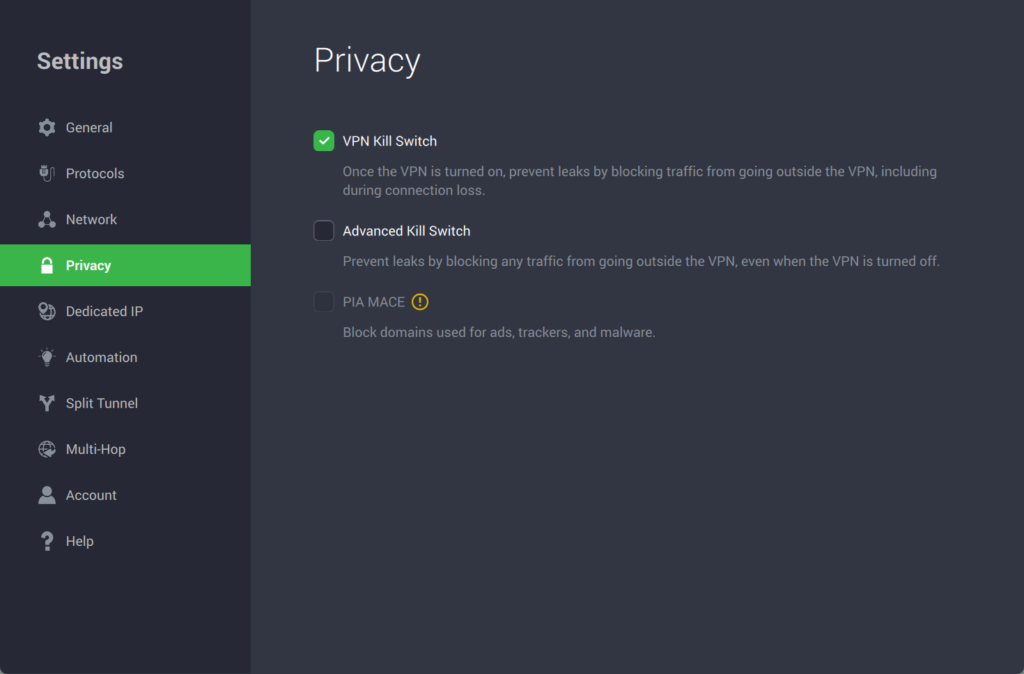
Both ExpressVPN and PIA come with a kill switch, which is designed to cut off your internet connection immediately if the VPN drops unexpectedly. This prevents your real IP address or other data from leaking through during a disconnection.
In practice, ExpressVPN’s kill switch (called Network Lock) is straightforward and works reliably across its apps, covering your entire connection. PIA also provides a kill switch, but it’s a bit more advanced, and you can set it to always block traffic unless the VPN is active, offering an “extra strict” mode. This makes PIA’s kill switch more customizable for users who want tighter control.
I suggest keeping the kill switch turned on, whether you’re using public Wi-Fi or handling sensitive data, as it ensures no accidental exposure occurs..
Split tunneling
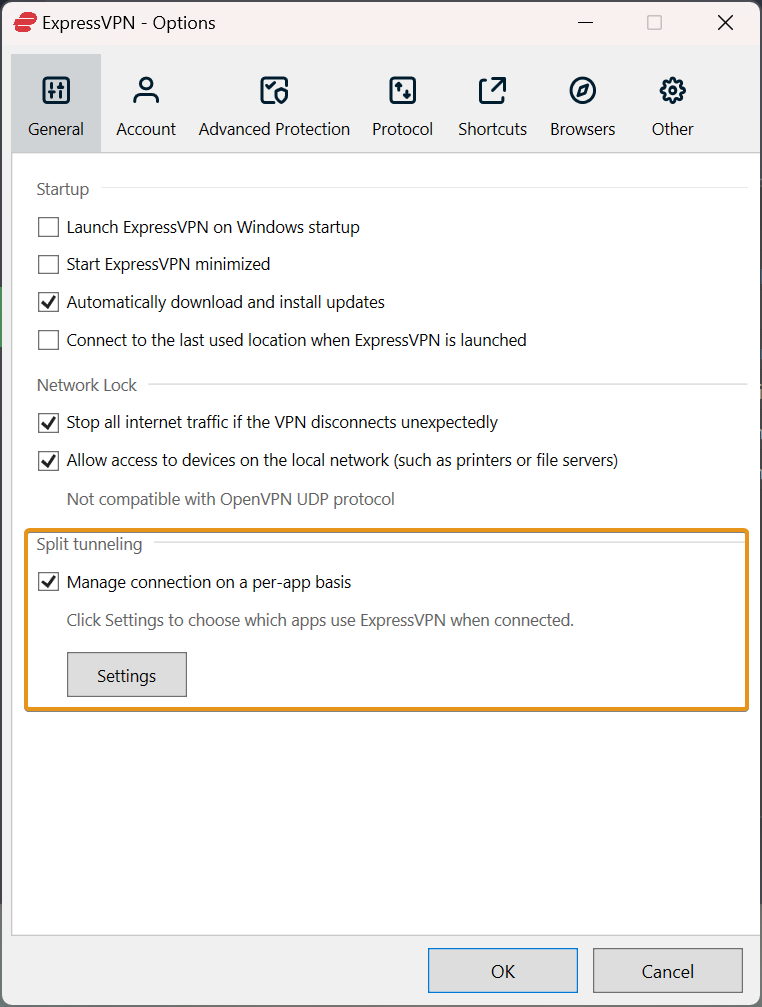
Split tunneling is a useful feature that allows you to choose which apps (or sometimes websites) route through the VPN and which connect directly to the internet. This is especially handy when you want to access local services while still running other traffic securely through the VPN.
ExpressVPN supports split tunneling on Windows, Mac, and Android apps, giving you selective control over apps that bypass the VPN. PIA also offers split tunneling on both desktop and mobile apps, with even more granular customization, letting you filter traffic on an app or domain-level basis.
For users who regularly balance secure activities (like online banking) with unrestricted local services, both providers do the job well, though PIA offers finer controls for tinkerers.
Obfuscation
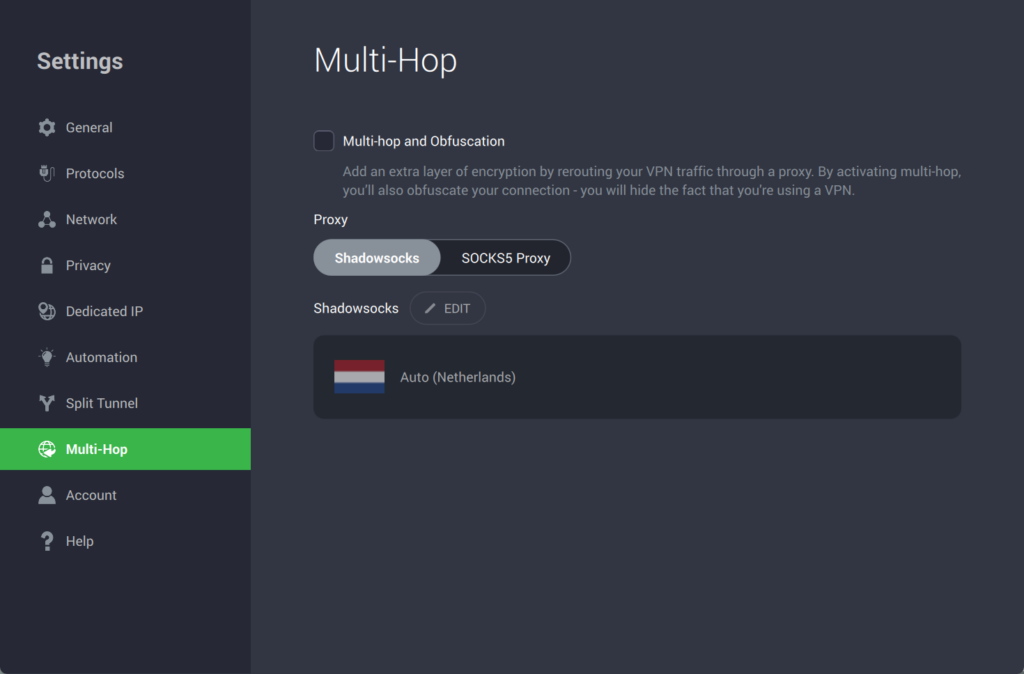
Obfuscation disguises VPN traffic as ordinary internet activity, which helps bypass strict firewalls and VPN detection systems often found in schools, workplaces, or countries with heavy censorship.
ExpressVPN includes obfuscation automatically on all servers when using certain protocols, so you don’t need to switch modes, as it will work automatically – even in restricted environments. PIA, on the other hand, requires enabling its Shadowsocks or SOCKS5 proxy integration for similar functionality, though it isn’t as universally available as ExpressVPN’s system.
If you frequently travel to or live in countries with limited internet freedom, ExpressVPN provides a more seamless and reliable obfuscation option, so you don’t need to think about safety.
Specialty servers
Specialty servers are VPN servers designed for specific needs, whether that’s enhanced security, file sharing, or bypassing advanced geo-restriction systems.
ExpressVPN doesn’t label servers as “specialty,” but all of its servers are RAM-only (TrustedServer technology), and it offers built-in options for obfuscation, split tunneling, and router installation. These give it flexibility for streaming, gaming, and privacy.
PIA, meanwhile, focuses on P2P-friendliness and port forwarding, which makes it particularly attractive for torrenting.
So, while PIA is well-suited for advanced torrent users who want maximum control, ExpressVPN is the better-rounded provider for streaming, censorship bypassing, and everyday privacy.
Ad & malware blocker
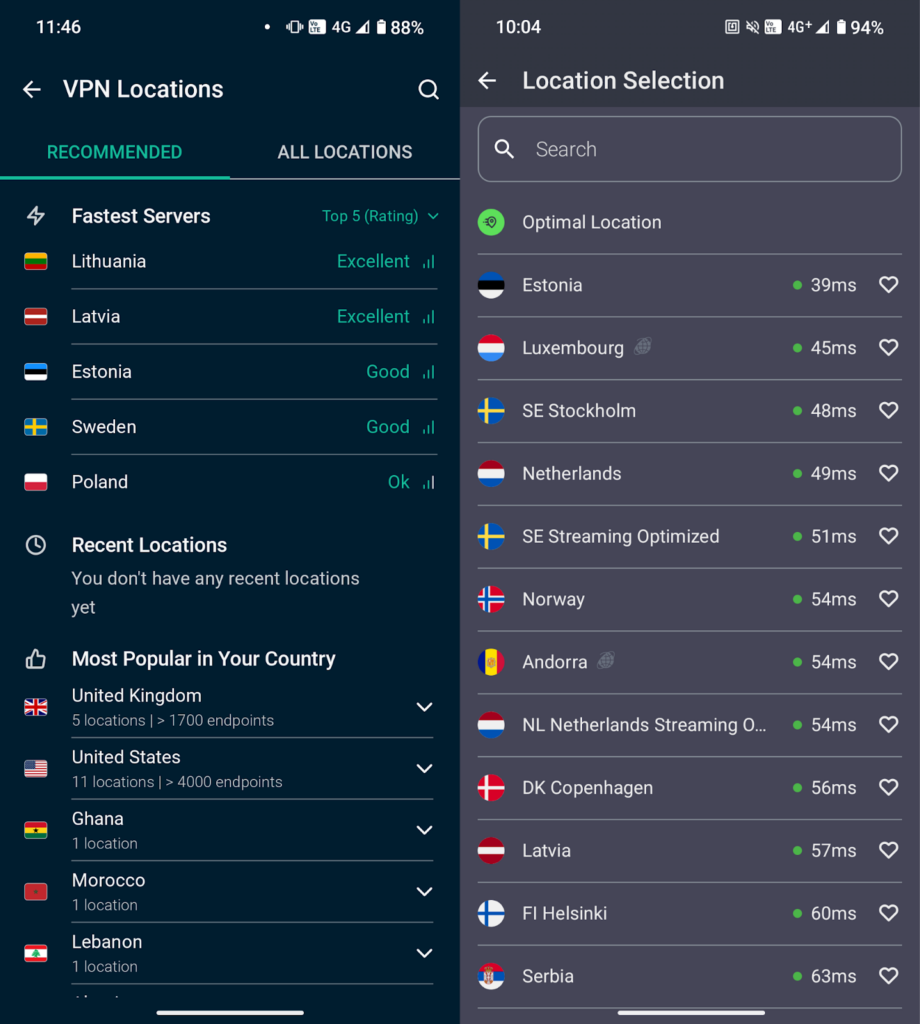
An ad and malware blocker works by blocking malicious websites, trackers, and annoying ads, creating a safer and cleaner browsing experience.
PIA includes a feature called MACE, which blocks ads, trackers, and known malware domains at the DNS level. It’s available directly in the app and easy to toggle on and off. ExpressVPN, by contrast, has recently expanded with its Threat Manager tool (available on iOS, Mac, Linux, and some other platforms), which blocks trackers and malicious domains, though it doesn’t yet filter ads as aggressively as PIA’s blocker.
If your priority is cutting down on ads and intrusive trackers, PIA has the edge here. For users who prefer malware and tracker prevention built into a broader security system, ExpressVPN’s Threat Manager does the job well.
Which VPN has stronger privacy policies: PIA or ExpressVPN
When it comes to privacy, ExpressVPN has the upper hand. The service is headquartered in the British Virgin Islands, a jurisdiction with no mandatory data retention requirements and outside the influence of intelligence-sharing alliances. Over the years, ExpressVPN has undergone several independent audits. The latest was completed in 2025, once again verifying its strict no-logs policy. Again, its entire server network runs on RAM-only TrustedServer technology, which wipes all data upon reboot, reducing the risk of long-term storage or compromise.Private Internet Access, meanwhile, has built trust by open-sourcing its apps and undergoing third-party audits that confirmed its no-logs commitment. However, it operates under US jurisdiction, which is part of the Five Eyes alliance and is subject to more aggressive surveillance laws. While PIA remains transparent in its practices, its legal environment makes it less privacy-friendly when compared to ExpressVPN’s offshore base and consistent independent verification. For users who view jurisdiction and audit history as essential, ExpressVPN delivers stronger overall reassurance.
No-logs policy
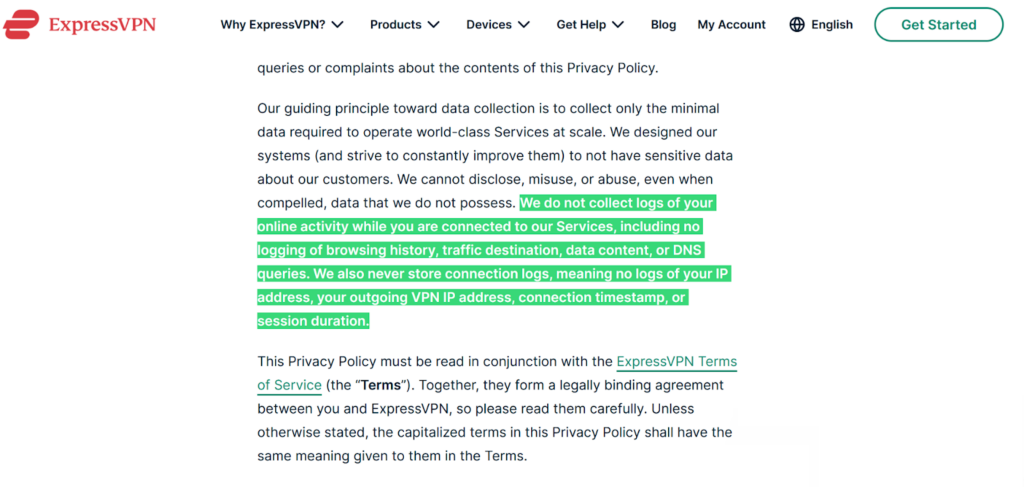
ExpressVPN and PIA both advertise strict no-logs policies, meaning neither tracks online activity, browsing history, or IP addresses. ExpressVPN strengthens this with independent third-party audits confirming its claims, alongside its BVI jurisdiction, which has no mandatory data retention laws.
PIA also enforces a strong no-logs approach and has undergone audits validating that it doesn’t log traffic. However, because it’s headquartered in the US, it operates under a legal environment known for surveillance and data requests. This doesn’t negate its commitment, but it adds more risk compared to ExpressVPN’s offshore positioning.
Independent audits & transparency reports
ExpressVPN stands apart with multiple independent audits carried out by firms such as PwC and Cure53, all verifying its security model and no-logs policy over the years. As previously mentioned, the VPN also runs its TrustedServer technology, ensuring all servers wipe data on reboot. These measures increase transparency and boost user confidence.
PIA has also had its claims independently audited and provides open-source clients to give users greater confidence in the code it runs. However, unlike ExpressVPN, PIA does not release regular transparency reports documenting requests from authorities, which makes it less open about how those rare situations are managed.
By comparison, ExpressVPN maintains a stronger, more transparent track record, offering greater practical assurance for privacy-focused users.
Which is better for streaming: PIA or ExpressVPN
During my streaming performance tests, ExpressVPN performed slightly better than PIA, providing faster and more stable connections overall. While PIA delivered respectable speeds that worked fine for more casual HD streaming, ExpressVPN’s Lightway protocol and globally distributed server network gave it a noticeable edge, keeping streams smooth at higher resolutions and minimizing buffering, even with 4K content.
| Streaming service | ExpressVPN | PIA |
| Netflix | ✅ Yes (multiple regional libraries) | ✅ Yes (US and some regions) |
| BBC iPlayer | ✅ Yes | ⚠️ Inconsistent |
| Disney Plus | ✅ Yes | ✅ Yes |
| Hulu | ✅ Yes | ✅ Yes (less reliable at times) |
| HBO Max | ✅ Yes | ❌ No |
| Amazon Prime Video | ✅ Yes | ❌ No |
| ITVX | ✅ Yes | ⚠️ Limited |
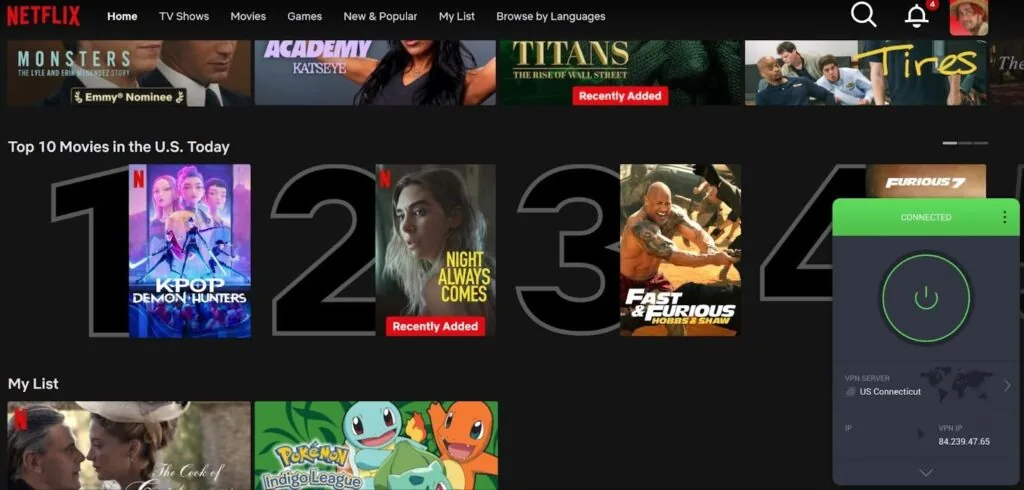
When it came to unblocking streaming platforms, ExpressVPN proved highly reliable. It granted access to every major service I tested, including multiple regional Netflix libraries (US, UK, Canada, and Japan), Disney+, BBC iPlayer, Hulu, and Amazon Prime Video. PIA managed to unlock Netflix and Hulu without much trouble, but had more struggles with stricter platforms like BBC iPlayer, HBO Max, and Prime Video, which are known for detecting and blocking VPNs more aggressively.
Should I choose ExpressVPN or PIA for torrenting?
A reliable VPN for torrenting is essential. It keeps your identity hidden, helps prevent ISP throttling, and lowers risks by encrypting data transfers and masking your IP address. I tested both ExpressVPN and Private Internet Access (PIA) for torrenting, looking closely at speed, stability, and P2P-focused features.ExpressVPN performed excellently, supporting torrenting on all of its servers with high-speed connections and a strong built-in kill switch that safeguarded my sessions. Downloads remained consistent and interruption-free, even when seeding or pulling larger files. PIA, meanwhile, also permits torrenting across its entire network but adds an edge with its port forwarding option, which can improve peer connections. However, in practice, I found ExpressVPN to offer faster, more dependable results overall, while PIA required a bit more tweaking to optimize performance.
Should I choose ExpressVPN or PIA for gaming?
When it comes to gaming, a VPN can help prevent DDoS attacks, reduce lag from ISP throttling, and unlock region-locked games or servers. I tested both ExpressVPN and Private Internet Access (PIA) with gaming specifically in mind, focusing on latency, stability, and device support.ExpressVPN stood out thanks to its low-latency performance and global server coverage, which helped keep ping times steady during competitive online matches. It provides unlimited bandwidth, so there’s no risk of throttling during extended sessions. Importantly, ExpressVPN also supports router installation, meaning you can cover entire networks, including gaming consoles, with one setup. Its reliable security infrastructure doubles as extra protection against DDoS attacks, which is a big plus for serious gamers.
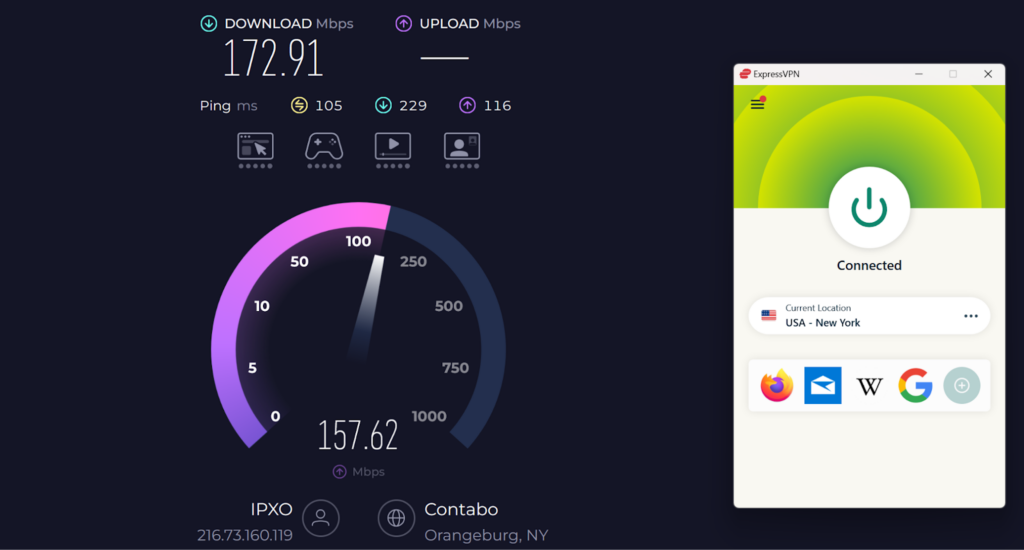
PIA, although offering unlimited bandwidth and a stable connection for casual gaming, doesn’t feature dedicated gaming servers and lacks router-level optimization guides that ExpressVPN provides. While it’s fast enough for everyday play, I did notice more ping fluctuation compared to ExpressVPN, making it less ideal for competitive players.
Which VPN is easier to use: PIA or ExpressVPN?
Based on my experience, both VPNs are easy to set up, with dedicated apps available for Windows, macOS, iOS, and Android. ExpressVPN’s installation process felt slightly more easy-going, with clear, step-by-step guidance during setup and automatic configuration options that made it all very beginner-friendly. PIA was also quick to install, but with more customization prompts upfront, which may appeal to advanced users but feel less intuitive for first-timers.
When it comes to interface, ExpressVPN stands out with its sleek, minimal design and one-click connection. Its server picker is clean, simple, and approachable, making it easy to switch between countries in seconds. PIA’s dashboard is functional and offers deeper customization options. It includes settings for encryption and ports, but has a more utilitarian look and requires some extra clicks for navigation compared to ExpressVPN’s streamlined feel.Both providers cover the major operating systems, but ExpressVPN has broader device support, extending to Linux, routers, smart TVs, gaming consoles, Amazon Fire TV Stick, and even browser extensions. PIA does support Linux and has browser add-ons, but its router setup is less documented and more technical. For anyone who wants flexibility across all kinds of devices, ExpressVPN is more friendly.
ExpressVPN vs PIA Reddit comparison
On Reddit, users frequently discuss the differences between ExpressVPN and Private Internet Access (PIA) when deciding which VPN to go with in 2025. Many comments praise ExpressVPN for its robust performance, consistent privacy protections, and exceptional streaming support, especially for services like Netflix, which tends to work with libraries from around the world. Redditors also highlight ExpressVPN’s speeds and broad server distribution, and reliable ability to bypass geo-blocks as key advantages.
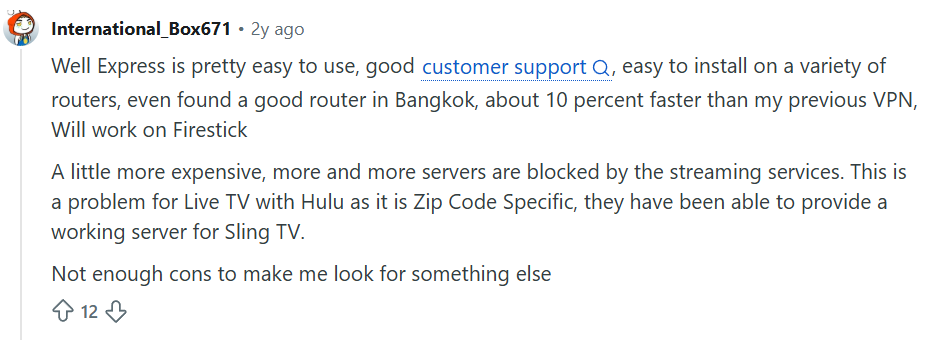
PIA receives positive remarks for its strong security features and excellent value, especially given its unlimited device connections and decent transparency. Many users appreciate PIA’s flexibility and affordability. However, some Redditors note PIA’s streaming capabilities aren’t as reliable as ExpressVPN’s, and its US jurisdiction raises concerns for privacy-conscious users.
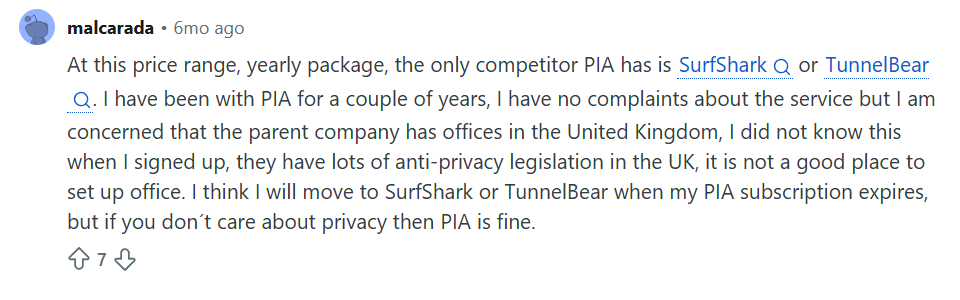
While both are solid choices, the consensus among Reddit users leans toward ExpressVPN as the preferred option for those seeking advanced privacy, better streaming, and superior speeds. PIA remains a respected choice for those prioritizing budget and configurability.
Final verdict: is ExpressVPN better than PIA in 2025?
Both ExpressVPN and Private Internet Access (PIA) provide dependable VPN services, but after thoroughly testing both across security, privacy, streaming, torrenting, gaming, and ease of use, ExpressVPN stands out as the stronger overall choice in 2025. The VPN’s advanced features, robust server network balanced across the globe, and superior speeds. The VPN’s independently audited privacy policies give it a clear advantage, too, especially for power users who demand high performance and stringent privacy at all times.
PIA remains a solid option for those who want an affordable, highly customizable VPN with unlimited device support and open-source transparency. However, it lags behind in streaming consistency and lacks some of the advanced features that make ExpressVPN a more versatile, user-friendly provider.
| When to choose ExpressVPN? | When to choose Private Internet Access (PIA)? |
| ✅ When you need fast, reliable streaming access and top speeds | ✅ When you want an affordable VPN with unlimited device connections |
| ✅ When privacy and independently audited no-logs policies are priorities | ✅ When you prefer a highly customizable VPN with open-source apps |
| ✅ When you require optimized torrenting and gaming performance | ✅ When your VPN needs are basic, like casual browsing |
| ✅ When you want wide device support, including routers and consoles | ✅ When you only need VPN coverage for standard desktops and mobile devices |
| ✅ When ease of use and a polished interface matter | ✅ When you want fine-grained control over security and connection settings |
- Pricing. PIA is a cheaper VPN than ExpressVPN. You can subscribe to PIA for just $ 2.19/month, while ExpressVPN subscriptions start at $ 2.99/month.
- Servers. PIA has more servers overall, around 35000 in 91+ countries, while ExpressVPN covers 113+ countries with around 3,000 servers. However, ExpressVPN offers RAM-only TrustedServer technology, which enables overall better server performance and reliability.
- Security. ExpressVPN is a slightly more secure service, providing proprietary Lightway protocol, a password manager, and a threat manager, giving it a slight edge for overall security.
- Privacy. PIA is based in the US and has several no-logs policy reviews. Meanwhile, ExpressVPN is based in the British Virgin Islands and has undergone tens of no-logs policy audits, making it a more private choice.
- Streaming. ExpressVPN is the better VPN for streaming, showing more consistency in unblocking streaming platforms, such as Netflix, HBO Max, Amazon Prime, Disney+, BBC iPlayer, and more.
- Torrenting. Although PIA offers port forwarding specifically for torrenting, ExpressVPN is overall easier to use and faster when it comes to torrenting.
- Gaming. ExpressVPN shows consistent low-latency performance for gaming, is compatible with routers, and offers stronger protection against DDoS attacks than PIA.
- Interface. Both services are relatively easy to use, but ExpressVPN offers a more modern, streamlined, and intuitive interface across different platforms.
You may also want to read:
- NordVPN vs Surfshark
- NordVPN vs Proton VPN
- NordVPN vs Surfshark vs ExpressVPN
- ExpressVPN vs NordVPN
- ExpressVPN vs Surfshark
- IPVanish vs ExpressVPN
- NordVPN vs CyberGhost
- CyberGhost vs Surfshark
- ExpressVPN or Surfshark
FAQ
ExpressVPN offers a more globally dispersed and optimized server network, superior streaming access, and advanced privacy features. PIA is known for its affordability, unlimited device support, and open-source customization, but has fewer specialty features and less consistent streaming performance.
Yes, ExpressVPN generally delivers stronger privacy protections and faster speeds. The VPN is also better for streaming and has broader device compatibility compared to PIA.
ExpressVPN tends to be faster than PIA thanks to its proprietary Lightway protocol, well-optimized servers, and wider geographic coverage that enhance both speed and stability.
ExpressVPN is typically more reliable for bypassing sports blackouts due to its larger international server network and proven ability to unblock popular streaming services worldwide. In my testing, ExpressVPN successfully bypassed blackouts for NFL Sunday Ticket, NBA League Pass, MLB.TV, and select Premier League matches, while PIA was less consistent, especially with region-locked games in the US and UK.